FieldRoutes review (2026): is it worth it for your pest business?
PestGrade is reader-supported. When you sign up for a tool through our links, we may earn a commission, at no cost to you, and it never affects our rankings. How we grade →
The short version: FieldRoutes earns a B+ for mid-size pest operators (roughly 5–50 techs). It’s purpose-built for pest control, includes Intelligent Routing and recurring billing, and integrates with Sentricon baiting systems. The catch: no public pricing, no self-serve free trial, and a steeper learning curve than lighter alternatives. For solo operators and small crews, GorillaDesk at $49–$149/mo with a 14-day trial is a simpler, more transparent entry point.
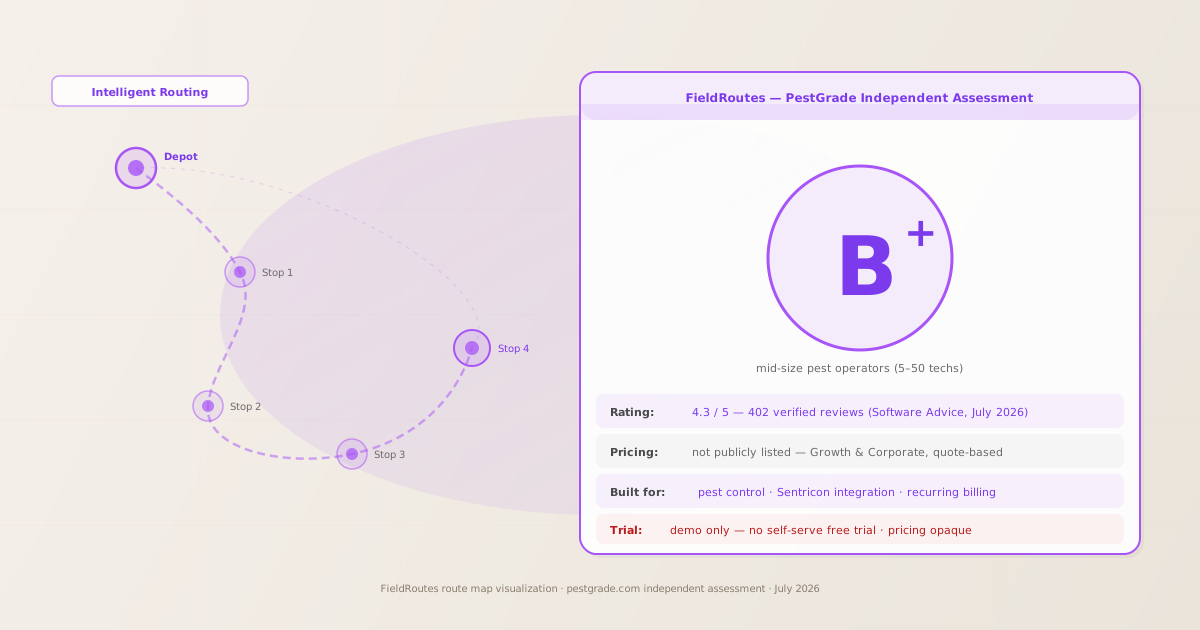
Grade + one-line verdict, by operator situation
- Mid-size pest operator (5–50 technicians, routing-dependent routes): Grade B+
- FieldRoutes is genuinely built for pest control, not a general home-services platform adapted for pest. It ships Intelligent Routing, recurring service management, automated customer communications, chemical/material tracking, and Sentricon integration out of the box. For a company running multiple routes and commercial accounts, this is a compelling stack. The B+ (not A) reflects real friction: opaque pricing requires a sales conversation, there’s no free trial, customer support reviews are mixed, and per-feature charges (texting, calling) add up after the quote.
- Solo operator or crew under 5 technicians: Grade C+
- FieldRoutes isn’t designed for solo or small-crew operations. The quote-only pricing process and demo-only trial create barriers that GorillaDesk ($49/mo, 14-day trial) eliminates. Reviewers on Software Advice describe a learning curve and navigation complexity that punishes small teams without dedicated admin support. For a 1–4 tech operation, GorillaDesk or Jobber gives you a faster, cheaper, more transparent path to the same core features.
- Commercial-heavy operator or scaling franchise (50+ techs, multiple branches): Grade A−
- FieldRoutes gains ground at commercial scale. The Corporate tier adds multi-location capabilities, commercial account management, and sales automation that lighter tools don’t cover. Sentricon integration handles bait-station monitoring for termite commercial accounts. The platform’s acquisition by ServiceTitan (2022) has brought deeper integrations and a more active product roadmap. Operators building toward regional scale will find more headroom here than in GorillaDesk or Jobber.
This assessment is based on FieldRoutes’ public feature pages, synthesized user feedback from Software Advice (4.3/5, 402 verified reviews, July 2026), and vendor documentation, not hands-on use. See how we grade →
FieldRoutes pricing, what’s publicly listed (and what isn’t)
FieldRoutes does not publish pricing on its website as of July 12, 2026. To get a number, you must request a demo or contact sales directly. What the company does disclose:
- Growth, “Ideal for Small Businesses”
- Entry tier with core scheduling, route optimization, recurring service management, mobile app, automated communications, payment processing, lead management, and reporting. Pricing is quote-based. The subscription model is described as “based on the number of active customers,” meaning costs scale with your customer count rather than a flat per-seat or per-tech rate. The growth model benefits operators with large customer volumes relative to tech count.
- Corporate, “Perfect for Scaling”
- Adds multi-branch capabilities, more advanced commercial account tools, sales center features, expanded reporting, and API integrations. Again, quote-based. For regional franchises or companies pushing toward 50+ technicians, the Corporate tier is the relevant conversation.
- Per-feature charges (the hidden cost)
- Multiple Software Advice reviewers flagged extra charges accumulating for texting and calling features beyond the base subscription. One reviewer summarized: “customer support is easy to contact; easy to schedule; a lot of features cost money.” Ask your sales rep specifically which communications features are included vs billed separately before signing.
- Data export fees (lock-in risk)
- A notable pattern across Software Advice reviews: operators describe “expensive data export fees” when trying to migrate away from FieldRoutes. This is a real switching cost that lighter tools don’t impose. If you’re evaluating FieldRoutes, ask explicitly what data portability costs and ensure it’s documented in your contract.
No free trial. FieldRoutes offers a free product demonstration, not a self-serve trial. Operators who want to run the software before a pricing conversation should note that GorillaDesk and Jobber both offer 14-day trials without a sales call required.
FieldRoutes at a glance, the numbers vs category norm
Compiled by PestGrade and verified against FieldRoutes’ live feature and pricing pages on July 12, 2026. Category norms represent the verified range across GorillaDesk, Jobber, Housecall Pro, QuoteIQ, FieldRoutes, and PestPac as assessed in our small business pillar guide.
| What to check |  FieldRoutes FieldRoutes |
Category norm |
|---|---|---|
| Entry price | Not publicly listedquote required | $29–$79/mo (publicly listed tools) |
| Pricing model | Volume-based (active customer count) | Per-seat or flat-rate |
| Tiers | Growth, Corporate | 2–4 tiers |
| Setup / onboarding fee | Not publicly listed | $0–$500+ (legacy platforms higher) |
| Contract required | Not publicly listed | Varies; lighter tools offer month-to-month |
| Free trial | ✗ Demo only, no self-serve trial | 14-day trial common (GorillaDesk, Jobber) |
| Route optimization | ✓ Intelligent Routing, all tiers | Varies; some gate routing to mid-tier |
| Recurring / subscription billing | ✓ Included (both tiers) | Mid-tier+ on general FSM tools |
| Automatic payments / autopay | ✓ Payment portals included | Mid-tier+ on most platforms |
| Mobile field app | ✓ iOS + Android (both tiers) | Standard across category |
| Chemical / material tracking | ✓ Listed as feature | Pest-specific tools include; general FSM tools don’t |
| Automated customer communications | ✓ Included (texting may incur extra fees) | Mid-tier+ on most platforms |
| Sentricon integration | ✓ Listed on pricing page | Rare; mainly FieldRoutes and PestPac |
| Lead management / CRM | ✓ Included | Upper-tier or add-on on most tools |
| Pest-specific design | ✓ Built for pest control | GorillaDesk, QuoteIQ, PestPac also pest-specific |
| Software Advice rating | 4.3/5 (402 reviews, July 2026) | Category avg. ~3.9–4.8/5 |
Feature data verified against FieldRoutes’ live pages on July 12, 2026. Pricing is “not publicly listed” obtained only via sales inquiry. Category norms based on PestGrade’s compiled data across 6 major pest control platforms.
FieldRoutes vs GorillaDesk, key feature and transparency comparison
PestGrade’s side-by-side compiled from both vendors’ live pages, July 12, 2026. “—” means the field is not publicly documented.
Routing, scheduling & automation
Routing is FieldRoutes’ strongest selling point. The platform’s Intelligent Routing engine optimizes daily and weekly service routes based on geography and job density, the same core function as GorillaDesk’s Drive Matrix, but marketed toward higher-volume operations where the efficiency gains compound more significantly.
Scheduling handles recurring service plans, one-time work, and customized frequency schedules (quarterly, monthly, seasonal, custom intervals). Software Advice reviewers specifically call out scheduling as a strength: one reviewer noted the software “simplifies appointment setting, route planning, and recurring service management.” The scheduling interface handles multi-tech route calendars in a way that solo-operator tools like QuoteIQ don’t need to.
Where the reviews get mixed: navigation complexity. Multiple Software Advice reviewers describe “confusing workflows and limited flexibility” for more granular tasks. One reviewer noted: “There are really basic things that are impossible to do so you have to get creative to make work-arounds.” This friction shows up more for smaller teams without dedicated office staff to manage the platform.
Automation: FieldRoutes includes automated customer communications (service confirmations, reminders, follow-ups), with reviewers noting extra per-message charges for texting and calling beyond the base subscription. Confirm what’s included vs metered before signing.
Recurring billing & payments
Recurring service billing is included on both FieldRoutes tiers, it’s not locked behind a higher plan, which is one differentiator versus general FSM tools like Jobber (Connect tier, $99/mo) or Housecall Pro (MAX tier, $299/mo). For pest operators whose whole revenue model is built on quarterly and annual service agreements, this matters.
The payment portal handles customer self-pay, card-on-file for autopay, and payment processing integration. FieldRoutes markets its billing as purpose-built for pest service agreements, not retrofitted from a generic invoicing module.
The opaque pricing model creates a complication: you can’t assess what percentage of your revenue goes to software costs without going through a full sales and quote process. Tools with published pricing (GorillaDesk: $49–$149/mo; Jobber: $49–$399/mo) let you run the math before any conversation. This isn’t a feature gap, but it’s a real operational decision for budget-conscious operators.
Mobile app & compliance
FieldRoutes ships a mobile field app for iOS and Android. Technicians use it to access route schedules, complete service notes, capture signatures, process payments, and log material/chemical usage on-site.
Chemical and material tracking is listed as a feature, techs can record what products were applied, at what concentration, and where. This covers the core pest compliance requirement for material usage logs. FieldRoutes’ pest-specific pedigree means the compliance workflow is designed for exterminator field use rather than tacked on as a generic notes field.
The Sentricon integration is one of the more distinctive features in the category. Sentricon is Dow/Corteva’s bait-station system for subterranean termite control; FieldRoutes connects to Sentricon data for bait-station monitoring and documentation, which is relevant for termite-heavy commercial accounts. GorillaDesk does not document a Sentricon integration.
Mobile app performance reviews on Software Advice are positive but with some stability notes. The desktop back-end interface has more navigation complaints than the mobile app itself.
What operators love, and what frustrates them
Source: Software Advice (4.3/5, 402 verified reviews, July 2026). Patterns below represent recurring themes across multiple reviewers, not isolated one-off opinions.
What operators love
- Industry-specific design
- Reviewers consistently describe FieldRoutes as “tailored for pest control needs” with tools that fit how a pest operation actually runs. One reviewer noted: “This program makes day-to-day pest control operations so smooth and easy.” The contrast with general FSM tools (Jobber, Housecall Pro) comes up repeatedly, operators who switched from general tools report fewer workarounds.
- Comprehensive built-in features
- Multiple reviewers call out the breadth of what’s included without expensive add-ons, billing, reporting, route management, communications, lead tracking. This contrasts with the perception that each major feature costs extra (though the hidden per-feature charges contradict this for some users).
- Scheduling and route management
- Consistently rated as smooth and effective. The recurring schedule management and route optimization receive specific praise for handling high-volume service calendars without manual calendar gymnastics.
What frustrates them
- Steep learning curve and navigation issues
- The most common complaint across Software Advice reviews. Reviewers describe “confusing workflows,” a back-end interface that requires significant training, and “limited flexibility” for tasks outside the standard workflow. One reviewer put it plainly: “There are really basic things that are impossible to do so you have to get creative to make work-arounds.” Smaller teams without office staff absorb this friction most.
- Customer support quality and response time
- Multiple reviewers flag “slow response times” and “lack of knowledgeable assistance.” Software Advice’s customer support rating (4.2/5) is decent but trails the platform’s scheduling/feature scores, and the pattern of support complaints is consistent enough to flag.
- Hidden per-feature charges
- Texting and calling features incur charges beyond the base subscription for some operators. One reviewer: “a lot of features cost money.” This is the kind of cost that doesn’t show up in the initial quote and compounds over months. Get a detailed cost breakdown for your specific usage patterns before signing.
- Data export fees and migration lock-in
- A significant pattern: operators describe expensive fees to export their own customer data if they later decide to migrate. This is a real switching cost that lighter tools like GorillaDesk don’t impose in the same way. If you’re evaluating FieldRoutes, ask explicitly what data export costs and ensure terms are in the contract.
Right for / wrong for
- ✓ Right for: mid-size pest operations (5–50 techs) with complex routing
- Multi-tech operations running dense residential or commercial routes get real value from Intelligent Routing. The volume-based pricing model also benefits companies with many customers relative to their tech count, unlike per-seat pricing, your software cost doesn’t scale with headcount.
- ✓ Right for: commercial-heavy operators with termite accounts
- Sentricon integration and the Corporate tier’s commercial account tools (CustomerConnect-style portals, advanced reporting) support commercial and institutional contracts. Operators with significant termite bait-station monitoring accounts will find features that GorillaDesk and Jobber don’t match.
- ✓ Right for: scaling businesses that need sales automation
- Lead management, marketing automation, and eCommerce tools are included at tier, features that lighter tools typically don’t have. Companies actively investing in customer acquisition alongside service operations will find more native tools here.
- ✗ Wrong for: solo operators and crews under 5 techs
- The pricing model, demo-only trial, and navigation complexity create a higher barrier to entry than alternatives. GorillaDesk’s Basic tier ($49/mo, 14-day trial, simple setup) covers scheduling, routing, and billing at a lower commitment level with transparent pricing. For a 1–4 tech shop, FieldRoutes is overkill and more expensive to evaluate.
- ✗ Wrong for: operators who need pricing transparency
- If your decision process requires knowing what something costs before you talk to a salesperson, FieldRoutes’ quote-only model is a disqualifier. GorillaDesk ($49–$149/mo) and Jobber ($49–$399/mo) publish full tier pricing. QuoteIQ also publishes pricing ($29.99–$699/mo). Buying FieldRoutes without a clear per-unit cost benchmark is harder to justify.
- ✗ Wrong for: operators who want a soft on-ramp
- No free trial means you’re committing to a sales process before seeing the product hands-on. Combined with the reported learning curve, this makes FieldRoutes a higher-stakes adoption than the alternatives with self-serve trials.
Our pick for mid-size pest operators: FieldRoutes
If you’re running 5+ techs on multiple routes and need a purpose-built pest platform with commercial capabilities, FieldRoutes earns its B+ for your situation. Request a demo to get your quote, and ask specifically about per-feature charges, data export terms, and the Growth vs Corporate tier distinction before signing.
PestGrade is reader-supported. When you sign up for a tool through our links, we may earn a commission, at no cost to you, and it never affects our rankings. How we grade →
Solo or small crew? See our GorillaDesk review or our best pest control software for small business guide for easier-entry alternatives.
Frequently asked questions
- Is FieldRoutes worth it for pest control?
- For mid-size operators (5–50 techs), it earns a B+: purpose-built for pest, solid routing, recurring billing, and Sentricon integration. For solo or small-crew operators, GorillaDesk or Jobber is a more transparent, lower-friction alternative. FieldRoutes skews toward growing and scaling operations, not bootstrapped one-truck shops.
- How much does FieldRoutes cost?
- FieldRoutes does not publish pricing publicly as of July 12, 2026. Pricing is quote-based, with costs tied to active customer volume rather than a flat per-seat fee. Contact FieldRoutes directly for a quote. Any specific dollar figure you find online is not a published rate, it’s from an individual quote or outdated data.
- Does FieldRoutes have a free trial?
- No. FieldRoutes offers a free demonstration, not a self-serve trial. GorillaDesk and Jobber both offer 14-day self-serve trials without requiring a sales call. If hands-on evaluation before pricing commitment matters, that’s a consideration.
- How does FieldRoutes compare to GorillaDesk?
- GorillaDesk wins on price transparency, trial availability, and simplicity for solo/small crews (4.8/5 on Software Advice). FieldRoutes competes at mid-size and commercial scale with Sentricon integration, volume-based pricing, and more advanced commercial account tools. Both are purpose-built for pest control. See our full GorillaDesk vs FieldRoutes comparison.
- What do operators say about FieldRoutes?
- Software Advice shows 4.3/5 (402 reviews, July 2026). Common praise: pest-specific design, scheduling, and routing. Common complaints: steep learning curve, slow support, extra charges for texting/calling, and expensive data export fees when switching platforms.
Related reading
Last verified: September 27, 2026. Assessment based on FieldRoutes’ public feature and pricing pages, synthesized user feedback from Software Advice (402 verified reviews), and vendor documentation, not hands-on use of the software. fieldroutes.com/pricing was re-read live on September 27, 2026 and is unchanged: still two named tiers, Growth (“ideal for small businesses”) and Corporate (“perfect for scaling”), still no dollar figures anywhere on the page, still a subscription “based on the number of active customers,” and still no free trial, which the page attributes to “the software’s highly customizable nature.” The Software Advice review data carries its own July 12, 2026 date and was not re-checked in this pass. How we grade →