FieldRoutes vs Jobber for pest control (2026): route automation vs generalist FSM
PestGrade is reader-supported. When you sign up for a tool through our links, we may earn a commission, at no cost to you, and it never affects our rankings. How we grade →
For an established pest operation running multi-truck routes:  FieldRoutesroute automation, chemical tracking, and marketing tools are all included. For a small or mixed-trade operation wanting transparent pricing and a free trial:
  Jobber from $49/mo. The hard stop: Jobber has no chemical tracking at any tier.
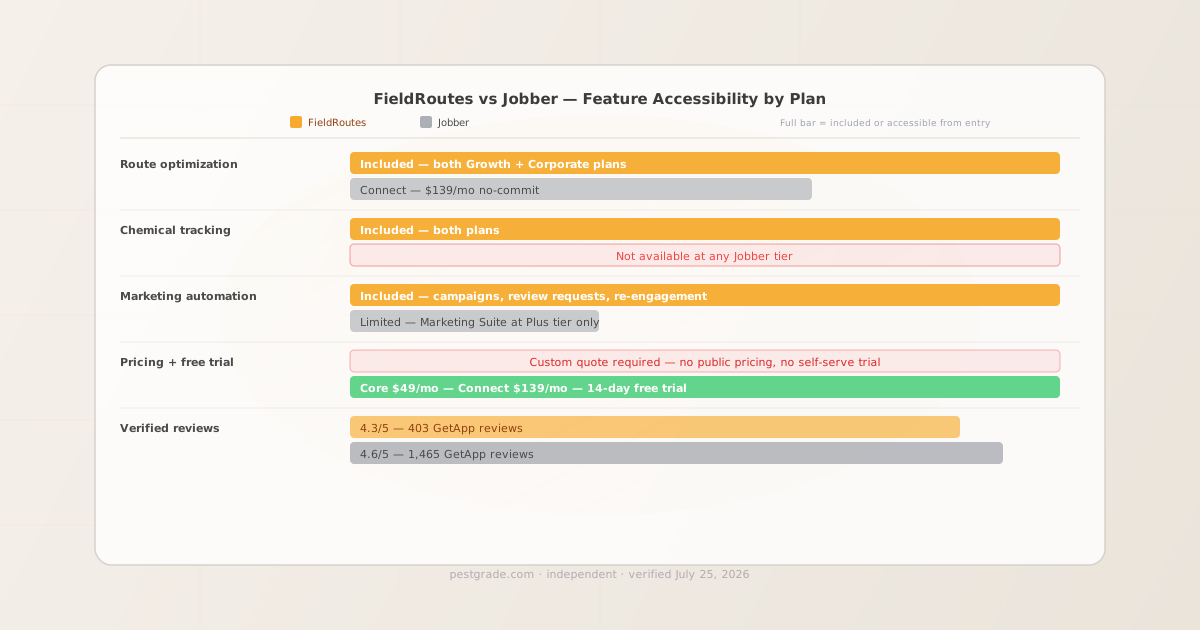
The verdict, scoped by operator situation
This is one of the more asymmetric comparisons in the pest software market: FieldRoutes and Jobber are built for different operator sizes, with different go-to-market models. Understanding that distinction resolves most of the comparison before you reach feature details.
- Established pest operation with 5+ technicians running structured daily routes: FieldRoutes
- FieldRoutes is purpose-built for multi-technician pest operations where route efficiency is a daily operational concern, not an occasional task. Route optimization, automated dispatch, chemical tracking, and a full marketing automation suite (automated review requests, re-engagement campaigns, customer communication sequences) are all included in both its Growth and Corporate plans, not tiered behind premium add-ons. The trade-off is full opacity on pricing: you cannot evaluate or trial FieldRoutes without a sales conversation. Annual and multi-year contracts are commonly reported by users on Capterra and G2, though contract terms are not publicly listed. For an operation that already knows what it needs and is large enough to justify an enterprise-tier vendor relationship, that friction is manageable. For smaller shops still evaluating options, it is a real barrier.
- Small pest operation (1–4 technicians), or a mixed-trade business running pest plus other service lines: Jobber from $49/mo Core
- Jobber publishes all pricing transparently, offers a 14-day free trial with no credit card required, and has no long-term contract obligation. For an operator evaluating multiple tools on their own schedule, the ability to start a trial without a sales call and cancel anytime is a meaningful risk reduction that FieldRoutes does not offer. Jobber’s cross-trade scheduling (handling pest, lawn, HVAC, and other service types in a single platform) makes it a strong fit for multi-trade businesses where pest is one of several service lines. Route optimization unlocks at the Grow tier, $199/mo no-commitment ($149/mo annual prepaid). The hard constraint for dedicated pest operators: Jobber does not include chemical or pesticide tracking at any price tier. For a licensed pest operator with FIFRA compliance obligations, that gap matters.
- Licensed pest operator who needs chemical tracking AND transparent pricing: Neither, evaluate GorillaDesk
- FieldRoutes includes chemical tracking but requires a custom quote conversation. Jobber has no chemical tracking at any tier. GorillaDesk includes chemical and material tracking from its Basic $49/mo entry tier with fully published pricing and a 14-day free trial. For a licensed operator whose compliance obligations include documented pesticide application records and who wants to evaluate tools independently, GorillaDesk is the more direct answer. See our chemical tracking comparison for a full feature breakdown.
- Pest operator whose primary differentiator is door-to-door or consumer marketing: FieldRoutes or Briostack
- FieldRoutes’s built-in marketing automation, automated review requests, re-engagement sequences, and customer communication tools, is a genuinely differentiating capability versus Jobber, which limits marketing suite access to its highest-tier Plus plan. For an operation where customer acquisition and retention marketing is a significant workflow, FieldRoutes’s integrated approach is meaningfully stronger than Jobber’s. Briostack adds a D2D-specific sales CRM that FieldRoutes does not offer; if door-to-door canvassing is central to the operation, see our Briostack review.
This comparison draws from live pricing verification (fieldroutes.com/pricing and getjobber.com/pricing, July 25, 2026), vendor feature documentation (getjobber.com/industries/pest-control-software/), 403 GetApp reviews for FieldRoutes and 1,465 GetApp/Capterra reviews for Jobber, not hands-on use in a live business. See how we grade.
Pricing compared, the transparency gap
The most significant structural difference between these two tools before evaluating any feature: FieldRoutes does not publish pricing. Jobber does. Data verified July 25, 2026 from fieldroutes.com/pricing and getjobber.com/pricing.
| Plan / term | FieldRoutes |
Jobber |
|---|---|---|
| Entry-tier price | Not publicly listed (custom quote required) | $49/mo no-commit, Core, 1 user |
| Entry tier (annual prepaid) | Not publicly listed | $29/mo × 12 = $348/yr (Core, 1 user) |
| Routing tier | Not publicly listed (routing included from entry) | $199/mo no-commit, Grow, 1–5 users |
| Routing tier (annual prepaid) | Not publicly listed | $149/mo × 12 = $1,788/yr (Grow, 1–5 users) |
| Pricing model | Active-customer-based (cost scales with customer count) | Flat per-tier + $29/mo each additional user |
| Free trial | ✗ Demo only, sales rep required | ✓ 14 days, full Grow plan access, no credit card |
| Contract terms | Not publicly listed; annual/multi-year reported by reviewers | Month-to-month, 1-yr commit, or annual prepaid, no long-term requirement |
| Setup / onboarding fees | Not publicly listed | None listed on pricing page |
| Additional users | Not publicly listed | $29/mo per additional user |
Data from fieldroutes.com/pricing and getjobber.com/pricing, verified July 25, 2026. FieldRoutes “not publicly listed” entries reflect information absent from the vendor’s public pricing page as of this date, contact FieldRoutes directly for a current quote. Jobber no-commitment pricing shown; 1-yr commit and annual prepaid options carry lower effective monthly costs.
Route optimization head-to-head
This is the area where the tools diverge most sharply, in both capability depth and pricing model. FieldRoutes is a routing-first platform by design, while Jobber’s routing is a useful mid-tier unlock rather than a core product identity.
FieldRoutes route optimization is built into every plan, both the Growth (small business) and Corporate (scaling) tiers include automated route sequencing, GPS tracking, and real-time technician monitoring. The platform’s routing engine considers drive time, stop density, and technician availability, and adjusts dynamically. Dispatch is automated to a degree that manual route-building is optional rather than required for daily operations. This is consistent with FieldRoutes’s ServiceTitan-era positioning as a routing-and-marketing-automation platform for established pest operations.
Jobber’s routing unlocks at the Grow tier ($199/mo no-commitment, $149/mo annual prepaid). It provides map-based scheduling, route optimization for the day’s jobs, and real-time technician GPS tracking. For a smaller operation running a single truck or doing informal route planning, Jobber’s routing is functional and well-integrated with its scheduling interface. For a multi-truck operation running structured routes with 20+ stops per day, FieldRoutes’s automation depth is meaningfully greater.
The pricing model difference also matters for routing economics: FieldRoutes pricing scales with your active customer count. As you grow your route density, you’re likely paying more per month. Jobber charges a flat tier rate plus a per-user fee, predictable, with no variable that scales automatically as you win customers.
Recurring billing & payments
| Feature | FieldRoutes |
Jobber |
|---|---|---|
| Recurring service plans / autopay | ✓ Included, both plans | ✓ Payment collection from Connect; recurring service plans from Grow tier |
| Card-on-file billing | ✓ Included | ✓ Available |
| Automated payment reminders | ✓ Included (marketing automation handles follow-up) | ✓ Automated reminders from Connect tier |
| QuickBooks Online sync | ✓ Via API (both plans) | ✓ From Connect $139/mo no-commit ($99/mo annual) |
| Consumer financing | Not publicly listed | Not listed on standard pricing page |
| ACH / bank transfer payments | Not publicly listed on pricing page | ✓ Available |
Feature data from fieldroutes.com and getjobber.com/pricing, verified July 25, 2026. “Not publicly listed” reflects absence from the vendor’s public documentation as of this date.
For pest control’s core billing workflow, quarterly or monthly recurring service contracts with autopay, both tools cover the basics. FieldRoutes includes recurring billing from the entry plan without an upgrade; Jobber gates recurring service plans more explicitly behind its Grow tier. If billing automation is the deciding factor and you’re at the smallest scale, FieldRoutes’s all-in-one-plan model has an advantage, tempered by its opaque pricing.
Chemical tracking & compliance, the decisive gap
For a licensed pest control operator in the United States, FIFRA (the Federal Insecticide, Fungicide, and Rodenticide Act) and most state licensing boards require documented records of pesticide application: which materials were used, at what rates, at which sites, on which dates. This is not optional record-keeping for most pest operations; it is a compliance obligation.
FieldRoutes includes chemical and material tracking as a standard feature in both its Growth and Corporate plans. Technicians can log materials used on each service call from the mobile app, and records are associated with the customer and service history. This makes FieldRoutes a viable choice for a compliance-conscious pest operation on the platform selection criteria that matter most for regulatory risk.
Jobber does not include chemical tracking as a dedicated workflow at any pricing tier (verified getjobber.com/pricing and feature documentation, July 25, 2026). Jobber’s pest-control-specific landing page references capturing “chemicals and pesticides used on the job along with their registration number” via custom job forms, but this is a custom form feature, not a structured compliance logging module with material, rate, and EPA registration number fields. For operators whose compliance obligations are documented-application records with regulatory rigor, this distinction matters. See our best chemical tracking comparison for a full breakdown of which tools include purpose-built compliance modules.
The bottom line: if chemical tracking is a compliance requirement, FieldRoutes is the viable choice in this head-to-head. If chemical tracking isn’t a core requirement (a multi-trade business where pest is a minor service line, or an unlicensed operation), this gap doesn’t resolve the comparison against Jobber.
Mobile field app & customer communications
FieldRoutes’s mobile app is purpose-built for pest technicians: logging materials used, capturing service completion, collecting customer signatures, and viewing route stop details all from the field. GPS tracking and real-time dispatch updates keep the office and the technician in sync without phone calls. Marketing automation runs independently, the office doesn’t manually trigger review requests or follow-up messages after each job.
Jobber’s mobile app is well-regarded for its iOS experience. The app handles scheduling, job checklists, photo capture, on-site invoicing, and payment collection. Jobber’s “On-my-way” texts notify customers automatically when a technician is en route. The cross-trade functionality that makes Jobber attractive for multi-service businesses is fully present in the mobile app. Capterra reviewers give Jobber high marks for ease of use and interface clarity. One recurring note in Capterra’s Jobber category: occasional glitches and slowdowns disrupting workflow, which appeared in the top two complaints in the verified review set (1,465 reviews, verified July 25, 2026).
For customer communications depth, FieldRoutes’s integrated marketing suite is a genuine differentiator: automated post-service review requests, re-engagement campaigns for lapsed customers, and appointment reminders run without manual setup per job. Jobber’s automated reminders and follow-ups are available from Connect onward, but the marketing suite (Marketing Suite in Plus) is its highest-tier add-on.
What operators love, and what frustrates them
Synthesized from 403 verified GetApp/Capterra reviews for FieldRoutes and 1,465 for Jobber (both verified July 25, 2026). Patterns only; no invented experience.
FieldRoutes, what operators report:
What they love: Multi-truck pest operations consistently highlight that route automation runs their daily dispatch without a separate daily planning session. Marketing automation for review generation and customer re-engagement is a frequently cited operational benefit. The fact that routing, billing, chemical tracking, and marketing are in a single integrated platform (rather than bolted-on integrations) is a recurring reason operators stay. Operators who run commercial accounts appreciate the service documentation and reporting capabilities for compliance audits.
What frustrates them: Performance issues and slowdowns appear consistently in Capterra’s FieldRoutes review set as the most common complaint, including payment processing glitches that create revenue-recognition headaches. Contract terms create lock-in: operators who want to switch face a process that is not as clean as the month-to-month alternatives. The pricing model based on active customer count means that as the operation grows, monthly costs rise in a way that is not fully predictable from the initial quote. The onboarding process requires significant time investment, and the learning curve for the full feature set is real. For smaller shops that only use a fraction of the platform’s capabilities, the complexity-to-value ratio can feel unbalanced.
Jobber, what operators report:
What they love: The interface is consistently cited as clean, intuitive, and easy to onboard without a training program. Scheduling is visual and drag-and-drop. The iOS mobile app receives strong marks. Cross-trade versatility is a genuine differentiator for multi-service businesses, operators running pest alongside lawn, HVAC, or other services get a single unified tool. The volume of integrations (35+, including PayPal, Stripe, Zapier, and QuickBooks) and the large user community create a broad support ecosystem. Reviewers frequently note that Jobber “just works” without requiring ongoing configuration.
What frustrates them: The most consistent complaints from Capterra’s 1,465 Jobber reviews are occasional glitches/slowdowns disrupting workflow and limited reporting options for operations that want deeper analytics. For dedicated pest operators, the absence of chemical tracking at any tier is a structural gap that no upgrade resolves. Route optimization only unlocking at $199/mo Grow, four times the $49/mo Core entry price, means the feature stack for a fully equipped pest operation costs more than the entry tier implies. The per-user fee ($29/mo each) makes Jobber meaningfully more expensive than some alternatives as the tech headcount grows.
Who FieldRoutes is wrong for: Solo operators or businesses with fewer than 5 technicians who do not yet need full route automation and marketing suite depth. Operations that want to evaluate software without a sales call. Shops on tight, predictable budgets that cannot absorb variable active-customer pricing.
Who Jobber is wrong for: Any pest operator for whom documented chemical usage is a compliance requirement, there is no tier that provides it. Multi-truck pest operations where daily route automation and deep dispatch management are core needs. Operations where a per-user fee model becomes expensive as the team scales.
Right for / wrong for, situational fit
| Operator situation | FieldRoutes |
Jobber |
|---|---|---|
| 5+ tech pest operation with daily routes | ✓ Built for this | Adequate, but routing requires $199/mo Grow |
| Solo or 1–2 tech operation | Likely overbuilt; custom pricing adds friction | ✓ Strong fit at $49/mo |
| Licensed pest operator needing chemical tracking | ✓ Included | ✗ Not available at any tier |
| Mixed-trade (pest + HVAC / lawn / other) | Pest-specific focus may limit cross-trade workflows | ✓ Cross-trade scheduling and quoting |
| Operator who wants a free trial before committing | ✗ Demo only, sales call required | ✓ 14-day free trial, no credit card |
| Marketing automation for review generation | ✓ Built-in automated campaigns | Marketing Suite only at Plus tier |
| Operations needing predictable flat-rate pricing | ✗ Active-customer-based, scales with growth | ✓ Flat per-tier + per-user |
| Commercial accounts with compliance documentation | ✓ Service documentation included | Not purpose-built for commercial compliance |
FAQ
- Is FieldRoutes better than Jobber for pest control?
- For an established pest operation running multi-technician routes, FieldRoutes is the stronger purpose-built choice: route automation, chemical tracking, and marketing automation are all included without upgrading. For a small or mixed-trade operation wanting transparent pricing and a free trial, Jobber is the better fit. The decisive constraint: Jobber has no chemical tracking at any tier.
- Does Jobber have chemical tracking for pest control?
- No. Jobber does not include chemical or pesticide tracking at any pricing tier as of July 25, 2026. Its pest-control page references capturing chemical registration numbers via custom job forms, but this is not a structured FIFRA-compliant usage logging module. For dedicated chemical tracking, FieldRoutes (with a demo call) or GorillaDesk ($49/mo, transparent pricing, 14-day trial) are more appropriate choices.
- How much does FieldRoutes cost compared to Jobber?
- FieldRoutes does not publish pricing, custom quote required. Jobber publishes transparent tier pricing: Core $49/mo no-commit ($29/mo annual); Connect $139/mo no-commit ($99/mo annual, adds QuickBooks sync and two-way texting); Grow $199/mo no-commit ($149/mo annual, unlocks routing); Plus $499/mo no-commit ($399/mo annual). Both pricing figures verified October 4, 2026.
- Does FieldRoutes offer a free trial?
- No. FieldRoutes offers a free demonstration only, which requires scheduling with a sales representative. Jobber offers a 14-day free trial with full Grow plan access and no credit card required.
- Which pest software has better route optimization, FieldRoutes or Jobber?
- FieldRoutes has deeper route optimization by design: it is included in all plans, with automated dispatch, optimized stop sequencing, and real-time GPS tracking as core features. Jobber’s routing (available from Grow $199/mo no-commit, $149/mo annual) is functional for smaller operations but is not the same depth as FieldRoutes’s purpose-built routing engine. For large multi-truck operations where daily route efficiency is a primary operational concern, FieldRoutes is the stronger choice. GorillaDesk offers Drive Matrix route optimization from $99/mo Pro with transparent pricing.
Our pick for established multi-truck pest operations: FieldRoutes
Route automation, chemical tracking, and marketing suite are included from entry, no tier upgrades needed. Best evaluated via a demo call given the custom pricing model. Not the right choice for solo operators or anyone who wants a free self-serve trial first.
PestGrade is reader-supported. When you sign up for a tool through our links, we may earn a commission, at no cost to you, and it never affects our rankings. How we grade →
Our pick for small operations and mixed-trade shops: Jobber from $49/mo
Transparent pricing, a 14-day free trial, and no long-term contract make Jobber the lower-friction starting point for smaller or multi-trade operations. Critical gap for dedicated pest operators: no chemical tracking at any tier. If chemical tracking is a compliance need, evaluate GorillaDesk at $49/mo instead.
PestGrade is reader-supported. When you sign up for a tool through our links, we may earn a commission, at no cost to you, and it never affects our rankings. How we grade →
Different situation? See our complete small business pest software comparison, or read how we grade.