Switching from Briostack: How to Migrate and What to Move To (2026)
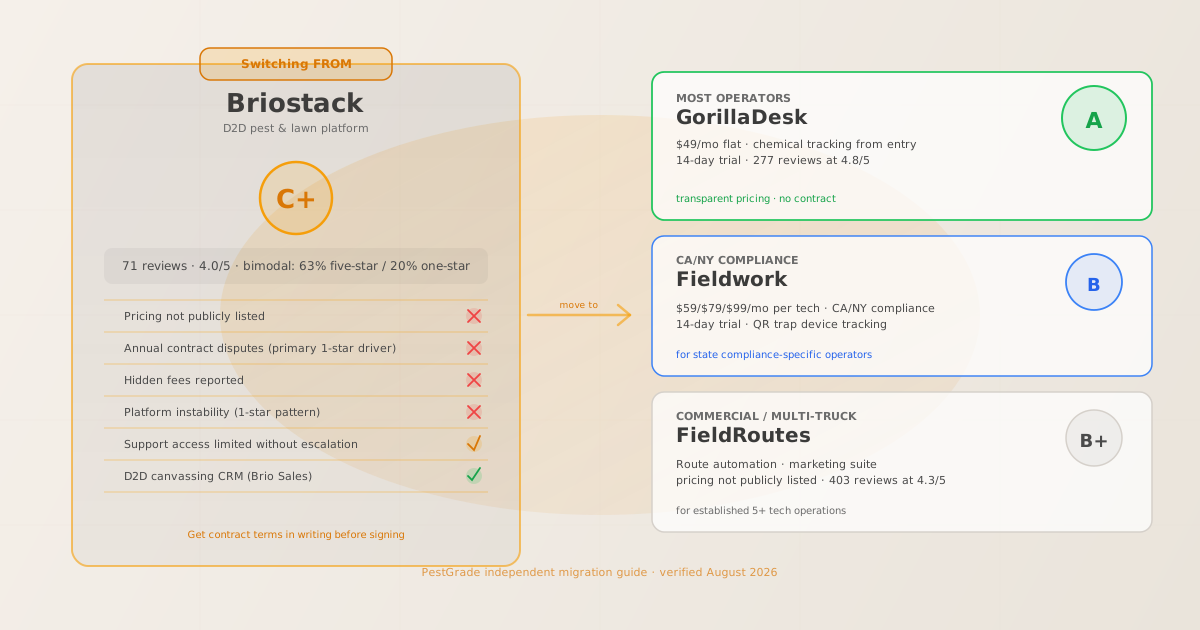
For most pest operators leaving Briostack: GorillaDesk ($49/mo, transparent published pricing, no contracts, chemical tracking from entry, 14-day free trial). Briostack's bimodal review profile (63% five-star / 20% one-star, 71 reviews) and undisclosed pricing make it harder to evaluate than tools with clean rating distributions and published rates.
PestGrade is reader-supported. When you sign up for a tool through our links, we may earn a commission, at no cost to you, and it never affects our rankings. How we grade →
Who should switch, and where to go
Before deciding to switch from Briostack, the first question is whether you actively use Brio Sales, the D2D canvassing CRM that is Briostack's primary differentiator. Operators who rely on territory management, canvassing leaderboards, and electronic door contracts for customer acquisition are in a different situation from those who signed up for the field service management tool alone. The migration calculus is different for each.
Switch to GorillaDesk if: You are using Briostack primarily as a scheduling, routing, and billing tool (not for D2D canvassing), and you are experiencing pricing opacity, contract disputes, or platform instability. GorillaDesk Basic at $49/mo offers published flat pricing, no contracts, chemical tracking from entry, and a 14-day free trial. GorillaDesk Pro at $99/mo adds Drive Matrix route optimization, confirmed subscription billing, customer portal, and QuickBooks sync. With 277 Capterra reviews at 4.8/5, GorillaDesk has 3.9 times Briostack's review volume and a clean rating distribution (not bimodal). GorillaDesk also advertises free data migration assistance, which reduces switching friction directly.
Switch to Fieldwork if: You are in California or New York where CA DPR or NY DEC state pesticide compliance report formats are required. Fieldwork Business at $79/mo per tech delivers these state-specific formats, QR trap device tracking, and route optimization. The 14-day free trial with no credit card required allows you to verify the compliance report format before committing. Fieldwork has 26 Capterra reviews at 4.9/5 (smaller sample than GorillaDesk but uniform positive).
Switch to FieldRoutes if: You are running a 5-plus technician operation with commercial pest accounts that require route automation, a marketing suite, and enterprise-grade reporting depth. FieldRoutes (ServiceTitan-owned) does not publish pricing (custom active-customer quote required), but has 403 GetApp reviews at 4.3/5 and delivers the marketing automation and Sentricon integration depth that smaller platforms do not replicate. This is an enterprise migration, not a budget move.
Consider Pocomos if: You are a D2D canvassing pest or pest-and-lawn operation that wants to stay within the D2D platform category but needs more pricing predictability than Briostack provides. Pocomos Starter at $99/mo (unlimited users, 0–20 active customers) includes D2D canvassing tools (territory management, canvassing leaderboards, electronic door contracts) and route optimization. Pricing is published and scales by active-customer count, not headcount. 35 GetApp/SoftwareAdvice reviews at 4.5/5.
Stay on Briostack if: You actively use Brio Sales for D2D canvassing with a dedicated sales team and are getting measurable acquisition results from territory management, canvassing leaderboards, and door contract capture. No published-price alternative fully replicates this workflow. The operators giving Briostack five stars are predominantly D2D-first operations where Brio Sales drives customer acquisition. If that describes your operation and your contract and cost are acceptable, the migration risk is real and the benefit may not exceed the cost of switching.
Why operators leave Briostack
Source: 71 SoftwareAdvice/GetApp reviews, pattern synthesis, verified August 9, 2026. PestGrade has not used Briostack in a live pest control business. Observations are attributed as user feedback from named platforms.
Briostack's review profile is bimodal in a way that warrants examination before either committing to the platform or dismissing it. 63% of 71 reviews are five-star; 20% are one-star. The five-star and one-star reviewers describe fundamentally different products. Understanding the split informs who should leave and who is likely to have a positive experience.
- Annual contract disputes and undisclosed fees: the primary one-star driver
- The most consistent pattern in Briostack's one-star reviews is not the software itself but the contract terms. Reviewers in this segment describe fees at signup that were not clearly communicated in advance, difficulty cancelling mid-contract, and charges after attempting to leave. One-star reviewers consistently describe the experience of being locked into an annual contract whose terms were not made clear before signing. This is a structural risk, not a product quality issue, and it affects operators who do not review contract terms carefully before signing. The defense is clear: request a complete copy of the contract and the full fee schedule in writing before committing to Briostack at any pricing level.
- Platform instability and reliability concerns
- A secondary one-star pattern involves platform reliability issues: reviewers describe downtime, unexpected feature behavior, and data concerns affecting their ability to run daily operations. GetApp sub-ratings show scheduling at 3.6/5 and routing at 3.7/5, notably lower than the overall 4.0/5 average. For a pest operation where scheduling and routing are core daily workflows, sub-ratings below 4.0 in those categories are relevant data points. Five-star reviewers do not typically mention reliability as a concern, which suggests reliability may be account-specific, network-related, or responsive to user type rather than a universal platform problem.
- Support accessibility and self-service limitations
- A recurring theme in mixed and negative reviews is the difficulty making account changes without involving support staff. Reviewers describe needing to contact support for administrative tasks they expected to handle independently. The GetApp feedback includes comments like "when posting payments the cursor goes from payment method down to check number then back up to dollar amount" from a reviewer who found the payment workflow counterintuitive. For a busy pest operation where administrative staff time is limited, software that requires support contact for routine changes creates friction that compounds over time.
- Pricing opacity: no public rates, demo required
- Briostack does not publish pricing on briostack.com (verified August 9, 2026). All pricing requires a demo conversation. This creates a fundamental disadvantage for operators comparing alternatives: you cannot model the Briostack cost against GorillaDesk, Fieldwork, or Jobber without entering a sales process. For pest operators evaluating platform switches, the inability to self-serve price comparisons is a meaningful friction point. Every other tool in this comparison (GorillaDesk, Fieldwork, Jobber, QuoteIQ, Pocomos) publishes pricing on their website. GetApp reviewers cite value for money at 3.9/5, which is below the category norm for tools at similar functional depth.
Briostack vs alternatives: side-by-side
| Feature | Briostack (leaving) |  GorillaDesk (most operators) GorillaDesk (most operators) |
Fieldwork (CA/NY compliance) |  FieldRoutes (commercial) FieldRoutes (commercial) |
|---|---|---|---|---|
| Entry price | Not publicly listed; demo required | $49/mo Basic | $59/mo Startup (per tech) | Not publicly listed; custom quote |
| Pricing model | Not published (reported demo-required, annual contract) | Flat per tier (3 tiers) | Flat per tech per month (3 tiers) | Active-customer (not published) |
| Contract terms | Annual contracts reported (primary 1-star complaint) | ✓ No contracts, no setup fees | ✓ No contract mentioned; 14-day trial | Not published; review contract |
| Free trial | ✗ Not listed on briostack.com | ✓ 14 days, no CC required | ✓ 14 days, no CC required | ✗ Demo only |
| Chemical tracking | ✓ Listed (Brio Tech field app) | ✓ From Basic ($49/mo) | ✓ CA DPR / NY DEC formats from $79/mo | ✓ Included |
| Route optimization | ✓ Listed (GetApp sub-rating 3.7/5) | ✓ Drive Matrix from Pro ($99/mo) | ✓ From Business ($79/mo per tech) | ✓ Intelligent Routing included |
| Recurring / subscription billing | ✓ Listed | ✓ Confirmed from Pro ($99/mo) | Listed; specific tier not confirmed | ✓ Included |
| D2D canvassing CRM | ✓ Brio Sales (primary differentiator) | ✗ Not listed | ✗ Not listed | ✗ Not listed |
| Data migration assistance | Contact support | ✓ Free migration advertised | ✓ 14-day trial for setup | Customer success team (enterprise) |
| Review volume / rating | 71 SoftwareAdvice reviews, 4.0/5 bimodal | 277 Capterra reviews, 4.8/5 | 26 Capterra reviews, 4.9/5 | 403 GetApp reviews, 4.3/5 |
Briostack data: briostack.com and SoftwareAdvice reviews, August 9, 2026. GorillaDesk pricing: gorilladesk.com/pricing, August 9, 2026. Fieldwork pricing: fieldworkhq.com, August 9, 2026. FieldRoutes pricing: not publicly listed, fieldroutes.com, August 9, 2026. Fields stated as "not publicly listed" or "not confirmed" are not published on the vendor's public pages.
The D2D question: if you use Brio Sales, switching is harder
Briostack's Brio Sales D2D canvassing CRM is the most cited positive differentiator in five-star reviews. If your pest or pest-and-lawn operation runs a dedicated door-to-door sales team that uses Brio Sales for territory management, canvassing leaderboards, lead tracking, and electronic door contracts, the migration decision is more complex than cost alone.
No published-price pest tool fully replicates Brio Sales. GorillaDesk, Fieldwork, and Jobber have no documented D2D canvassing CRM equivalent. Pocomos ($99/mo Starter, unlimited users) documents territory management, canvassing leaderboards, and electronic door contracts from its entry tier, and is the closest published-price alternative for this specific workflow. Briostack reviews from D2D-first operations are consistently positive; the bimodal distribution appears driven by operators using the field service management tools without the D2D layer.
If you are seriously evaluating a switch from Briostack and your D2D canvassing operations drive meaningful customer acquisition, the relevant questions before deciding are:
- What percentage of your new customers come through the D2D canvassing workflow vs inbound inquiries, referrals, or marketing?
- Can that acquisition channel be rebuilt on a new platform within an acceptable transition period?
- What is the value of one year's D2D-driven acquisition vs the cost of staying on Briostack?
If D2D acquisition is material, the migration cost includes rebuilding a canvassing workflow, not just importing customer data. For operations where D2D is incidental or where canvassing is done with separate external tools, this consideration doesn't apply.
How migration actually works: data export, contracts, timing
- Step 1: Review your Briostack contract before anything else
- The most common Briostack one-star complaint is contract-related, which means this step is the most important. Locate your current Briostack contract and identify: (a) the contract end date and auto-renewal window (many SaaS contracts auto-renew 30 to 60 days before expiry, meaning you must notify non-renewal earlier than you might expect); (b) any early-termination fees; (c) fee schedule for services beyond the base subscription. If you cannot locate your contract, contact your Briostack account representative and request a copy in writing before taking any further action. Calculate the cost of exiting early vs waiting for the renewal date. For operators mid-contract, the early-exit cost vs monthly savings on the destination platform determines whether to switch now or at renewal.
- Step 2: Inventory what data you need to export from Briostack
- Before contacting Briostack about a data export, list what your destination platform needs to import. At minimum: (1) Customer records with service addresses, contact information, and account notes; (2) Active recurring service agreements and billing schedules (which customers are on quarterly or monthly service, at what rate, and when their next service is due); (3) Service history per account (at least 2 years for residential, 5 years for commercial accounts that carry audit obligations); (4) Chemical application logs for state compliance records, especially if you are in CA or NY; (5) Route assignments and technician associations; (6) Active payment information. Note: raw card-on-file data is PCI-scoped and cannot be transferred between payment processors. Customers on autopay will need to re-enter payment details on the new platform. This is standard and expected, not a Briostack-specific limitation.
- Step 3: Request your data export from Briostack support, before you commit to a destination
- Briostack does not publicly document its data export formats or timelines. Contact Briostack support directly to understand what data is exportable, in what format (CSV, JSON, or proprietary export), and how long the process takes. Get this information before selecting a destination platform, so you can verify the destination can import Briostack's export format. GorillaDesk advertises free data migration assistance and has a customer success team with experience migrating from pest platform exports. Start a GorillaDesk 14-day trial, share the export format with their migration team, and confirm compatibility before cancelling Briostack.
- Step 4: Set up and verify the destination platform before cutover
- For GorillaDesk: import a test batch of customer records during the 14-day free trial and verify that service addresses, recurring schedules, and service history import correctly. Set up one or two routes in the system and run through the mobile app workflow with a technician before switching over the full customer base. For Fieldwork: use the 14-day trial to verify CA DPR or NY DEC compliance report output, if that is a key requirement, before fully committing. For FieldRoutes: work with the FieldRoutes customer success team to configure enterprise settings and verify route automation before cutover, given the complexity of the migration at that scale.
- Step 5: Run both systems in parallel for at least 2 to 4 weeks
- A parallel-run period allows you to catch import errors before they cause customer service problems. Run active scheduling and new jobs in the destination platform while keeping Briostack accessible as a reference for historical data. The parallel period should cover at least one full billing cycle to confirm invoices generate correctly in the new system and recurring billing works as expected. Budget for one month of dual subscription costs as a migration expense. This is standard practice and is not a sign that the migration is failing.
- Step 6: Notify Briostack of cancellation according to your contract terms
- Once the destination platform is running correctly and your team is trained, submit your Briostack cancellation according to the contract terms identified in Step 1. If your contract has a notice period (30, 60, or 90 days), submit notice before that window expires relative to your contract end date. Request written confirmation of cancellation and any final billing amount in writing. Keep a copy of the cancellation confirmation and the final invoice for your records.
What operators say about Briostack, synthesized from verified sources
Sources: SoftwareAdvice/GetApp (71 Briostack reviews, August 9, 2026); GetApp (277 GorillaDesk reviews for destination comparison). PestGrade has not used Briostack or GorillaDesk in a live pest control business.
What satisfied Briostack operators cite as reasons to stay
- Brio Sales D2D canvassing workflow: the genuine strength
- The five-star majority consistently describes Brio Sales as a material business driver. Territory management that prevents rep overlap, canvassing leaderboards that create rep-level accountability, and electronic door contracts that compress the time from knock to signed recurring agreement are cited as genuinely reducing the friction of D2D operations. Reviewers who use Brio Sales for customer acquisition describe it as operationally irreplaceable rather than a nice-to-have. For D2D-first pest and lawn operations, this is the core reason to stay.
- Communication tools within the platform
- Multiple five-star reviewers specifically mention Briostack's in-platform customer communication tools (text and email from the platform without switching tools) as a workflow convenience. The ability to manage customer contact from within the scheduling and billing context, rather than switching to separate communication tools, reduces the administrative overhead for small office teams.
What frustrated operators cite as reasons to leave
- Annual contract and fee transparency: the dominant one-star pattern
- The most specific and consistent negative pattern across one-star reviews is contract-related. Reviewers describe signing up without fully understanding the annual commitment and fee structure, then encountering difficulty exiting. The pattern is specific enough (multiple reviewers across different time periods describing similar contract-exit experiences) to reflect a structural concern rather than isolated incidents. For any operator currently evaluating Briostack, this pattern should prompt a careful review of contract terms before signing. For operators already on Briostack and experiencing this issue: review your contract, identify your exit timing, and calculate whether early exit or renewal-date exit is the cost-efficient path.
- Scheduling and routing sub-ratings below expectations
- GetApp sub-ratings show scheduling at 3.6/5 and routing at 3.7/5, both below the overall 4.0/5 average. For tools whose core value proposition includes scheduling optimization and route efficiency, sub-ratings below 4.0 in those categories indicate that a meaningful subset of operators finds the core workflow underperforming. GorillaDesk's comparable sub-ratings (where available) are consistent with its 4.8/5 overall rating, suggesting a more uniform experience across workflows.
- Support access requiring escalation for routine changes
- Multiple mixed-rating reviewers describe needing to contact Briostack support for administrative tasks that they expected to handle independently, such as account modifications and payment adjustments. The GetApp reviewer who described the payment-entry cursor workflow as awkward ("curser goes from payment method down to check # then back up to $ amount") illustrates the kind of UX friction that compounds into daily administrative time costs. For pest operations with limited back-office support, software that requires frequent vendor contact for routine management is a meaningful operational cost.
For most pest operators leaving Briostack: GorillaDesk
Transparent flat pricing ($49/mo Basic, $99/mo Pro with routing and confirmed subscription billing, $149/mo Growth), no annual contracts, chemical tracking from entry, 277 Capterra reviews at 4.8/5, free data migration assistance, and a 14-day free trial with no credit card required. GorillaDesk directly addresses the three most common Briostack exit drivers: pricing opacity, contract friction, and inconsistent platform experience. Start the 14-day trial, share your Briostack export with GorillaDesk's migration team, and verify data compatibility before cancelling.
PestGrade is reader-supported. When you sign up for a tool through our links, we may earn a commission, at no cost to you, and it never affects our rankings. How we grade →
For CA/NY compliance operators leaving Briostack: Fieldwork
If California or New York state pesticide compliance report formats are a hard requirement for your operation, Fieldwork Business at $79/mo per tech delivers CA DPR and NY DEC state-specific formats, QR trap device tracking, and route optimization on the same tier, with a 14-day free trial and no credit card required. Verify the compliance report format during the trial before committing.
PestGrade is reader-supported. When you sign up for a tool through our links, we may earn a commission, at no cost to you, and it never affects our rankings. How we grade →
For D2D canvassing operations staying in the category: Pocomos
If your growth model is door-to-door canvassing with a dedicated sales team, and you want more pricing predictability than Briostack offers, Pocomos Starter at $99/mo for unlimited users includes territory management, canvassing leaderboards, electronic door contracts, and visual route optimization. Pricing is published and scales by active-customer count. Request a demo and specifically ask for a trial period to evaluate the D2D canvassing workflow before committing.
PestGrade is reader-supported. When you sign up for a tool through our links, we may earn a commission, at no cost to you, and it never affects our rankings. How we grade →
Different situation? See the full Briostack alternatives guide, the switching from PestPac guide for comparison, or how we grade →
Related reading
Frequently asked questions
- What is the best alternative to Briostack for most pest operators?
- GorillaDesk is the strongest alternative for most pest operators: $49/mo Basic (transparent pricing, no contracts, chemical tracking from entry), $99/mo Pro (routing, subscription billing, QuickBooks sync). 277 Capterra reviews at 4.8/5. 14-day free trial, no credit card. Free data migration assistance. GorillaDesk directly addresses Briostack's primary exit drivers: pricing opacity, annual contract friction, and the bimodal review distribution. For CA/NY compliance-specific operators: Fieldwork at $79/mo Business. For D2D operations: Pocomos at $99/mo Starter.
- Why do operators leave Briostack?
- The primary pattern in Briostack's one-star reviews (20% of 71 SoftwareAdvice reviews) is annual contract disputes and undisclosed fees at signup. Secondary patterns include platform instability and support access difficulties. GetApp sub-ratings show scheduling at 3.6/5 and routing at 3.7/5, below the 4.0/5 overall average. The five-star majority (63%) are predominantly D2D-first operations using Brio Sales for customer acquisition. Operators using Briostack primarily for scheduling and billing without the D2D layer show more mixed results.
- What data can you export from Briostack when switching?
- Briostack does not publicly document its data export formats. Contact Briostack support directly before committing to a destination platform, and request your full data export: customer records, recurring service agreements, service history, chemical application logs, route assignments, and payment information. Raw card-on-file data is PCI-scoped and cannot be transferred between processors, customers will need to re-enter payment details on the new platform. GorillaDesk advertises free data migration assistance.
- How long does switching from Briostack take?
- Plan for 4 to 8 weeks from decision to full cutover: 1 to 2 weeks for data export, 1 to 2 weeks to import and verify in the destination platform, and 2 to 4 weeks of parallel operation before cancelling Briostack access. Budget for one month of dual subscription costs. Review your Briostack contract for the notice period required before cancellation to avoid auto-renewal into another annual term.
- Should D2D pest operations switch from Briostack?
- Not necessarily. Brio Sales (Briostack's D2D canvassing CRM) is genuinely differentiated: territory management, canvassing leaderboards, and electronic door contracts are purpose-built tools that most alternatives do not replicate. Operators who actively use Brio Sales for customer acquisition should weigh the D2D tool value against the platform risk before deciding. Pocomos ($99/mo Starter, unlimited users) is the published-price alternative with D2D capabilities if staying in the D2D category matters.
Last verified: August 9, 2026. Briostack data sourced from briostack.com and SoftwareAdvice/GetApp (71 reviews), verified August 9, 2026. GorillaDesk pricing verified from gorilladesk.com/pricing, August 9, 2026. Fieldwork pricing verified from fieldworkhq.com, August 9, 2026. FieldRoutes pricing not publicly listed on fieldroutes.com, verified August 9, 2026. Operator feedback synthesized from SoftwareAdvice and GetApp reviews, attributed as user feedback from named platforms. PestGrade assesses tools from public demos, verified user reviews, and vendor documentation, never hands-on use in a live pest control business. See how we grade →