Switching from FieldRoutes: How to Migrate and What to Move To (2026)
PestGrade is reader-supported. When you sign up for a tool through our links, we may earn a commission, at no cost to you, and it never affects our rankings. How we grade →
For most operators leaving FieldRoutes over cost or pricing opacity: GorillaDesk ($49/mo, published pricing, free data migration). For commercial-heavy operations leaving FieldRoutes for compliance depth or reporting: PestPac. FieldRoutes’ active-customer pricing model means your cost grows as your customer count does, the alternatives listed here publish flat-rate pricing from day one.
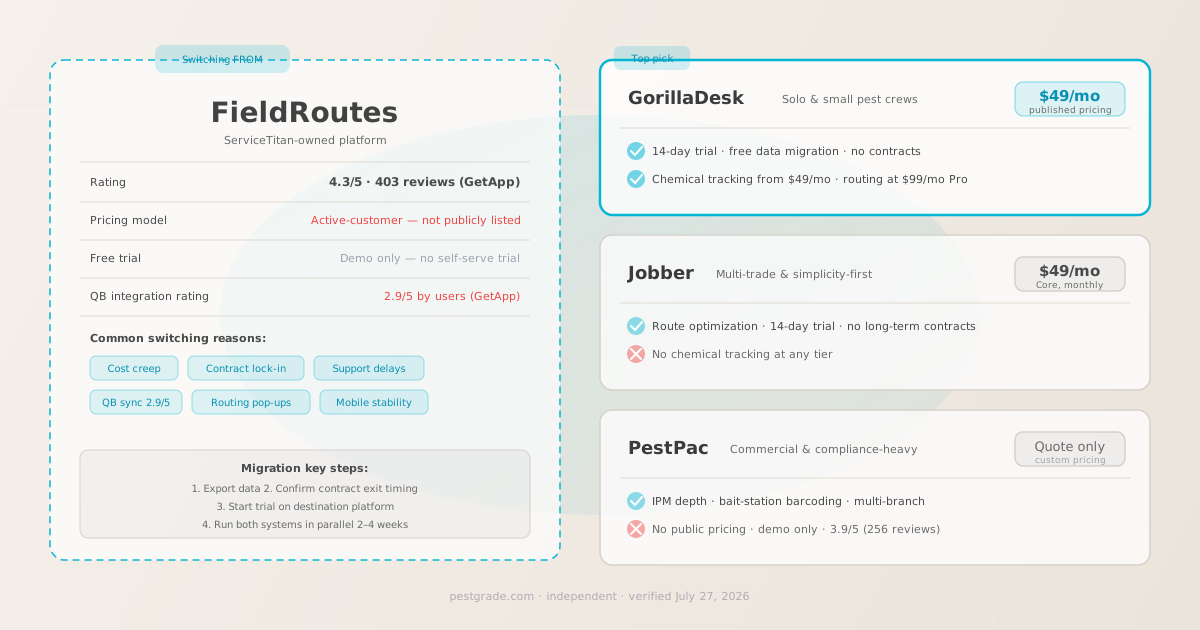
The short answer, who should switch and where to go
- Leaving because FieldRoutes cost keeps rising with your customer count: GorillaDesk
- FieldRoutes uses active-customer pricing, your monthly bill scales with the number of customers on service, not a flat per-tech rate. Operators in the review community report estimated costs around $350/mo per 1,000 active customers (cited in multiple forum discussions; not officially confirmed by FieldRoutes). If your customer base is growing and so is your FieldRoutes bill in ways you didn’t budget for, GorillaDesk offers a direct contrast: $49/mo Basic, $99/mo Pro, $149/mo Growth, flat monthly rates, published, no surprise increases as you acquire more accounts. GorillaDesk earns 4.8/5 from 277 GetApp reviews (verified July 27, 2026) and advertises free data migration assistance.
- Leaving for a modern UX that still handles pest-specific compliance: GorillaDesk
- GetApp reviewers highlight FieldRoutes’ mobile app at 3.4/5 for stability, “occasional glitches and crashes” surface as a pattern across negative reviews (GetApp, 403 reviews, verified July 27, 2026). If technicians are working around mobile issues or schedulers are frustrated by routing pop-up windows, GorillaDesk’s 4.8/5 rating and 4.9/5 on scheduling specifically reflect a meaningfully better experience for solo to 15-tech operations. GorillaDesk includes chemical/material tracking at every tier from $49/mo, no separate compliance module required.
- Leaving because FieldRoutes is more than your operation needs (simplicity-first): Jobber
- FieldRoutes is designed for multi-truck residential and commercial operations with marketing automation, Intelligent Routing, and a full CRM suite. If you run a smaller shop and use maybe 20–30% of that feature set, the cost-to-value ratio is poor. Jobber Core ($49/mo monthly) offers a lean field service platform with solid scheduling, invoicing, client portal, and a 14-day free trial. Caveat: Jobber includes no pest-specific chemical tracking at any tier, so it is a fit only if compliance documentation is handled separately or is not a daily operational requirement.
- Leaving because FieldRoutes lacks the commercial compliance depth you need: PestPac
- If your operation runs 20–50+ technicians managing commercial accounts, multi-location clients, bait-station barcoding, WDO/WDIR reports, IPM Logbook, and you are leaving FieldRoutes specifically for those gaps, PestPac (WorkWave) is the closest commercial-grade alternative. It does not publish pricing either, and its 3.9/5 from 256 reviews (verified July 27, 2026) is lower than FieldRoutes’ 4.3/5, so evaluate carefully. PestPac is not an improvement in UX; it is an improvement in commercial-compliance depth.
- Staying on FieldRoutes makes sense if: the marketing automation suite is actively driving revenue
- FieldRoutes includes automated re-engagement campaigns, review request workflows, and a lead management suite that smaller platforms do not replicate. If your operation relies on these to drive upsells, winbacks, and review generation, and the active-customer cost is sustainable at your current scale, migration risk likely outweighs the pricing benefit of switching. The operators who are satisfied with FieldRoutes in GetApp reviews consistently cite the unified platform and automation as the reason they stay.
Signs you’ve outgrown (or been priced out of) FieldRoutes
- Your monthly cost keeps climbing without a change in features
- FieldRoutes’ active-customer pricing model means the more accounts you service, the more you pay, even if you are using the same features as when you started. For a growing pest operation, this creates a structural cost problem: success on the customer acquisition side directly increases your software overhead. GetApp reviewers describe FieldRoutes as “expensive for small companies” with frustration over “extra costs and a lack of pricing transparency” (403 reviews, verified July 27, 2026). If you received an unexpected renewal invoice or received a cost-increase notice tied to customer count growth, that is the active-customer model working as designed, not a billing error.
- You are being charged for features you cannot identify using
- One GetApp reviewer noted: “I NEVER use FieldRoutes system to call or text my customers, but I always get charges.” If your FieldRoutes invoice includes line items for usage-based features, SMS, automated calling, or route add-ons, that you are not actively using, audit those before your next renewal. These charges may be preventable. They are also a signal that the platform is sized for a different type of operation than yours.
- Your technicians and schedulers are working around the software
- FieldRoutes’ mobile app is rated 3.4/5 on GetApp for mobile access (403 reviews, verified July 27, 2026). Schedulers specifically note that “the recommended routes pop up window is extremely aggravating for schedulers and slows down our process repeatedly.” If field techs are using workarounds, paper logs, phone calls to dispatch, manual re-entry, you are paying for automation that is not reducing your field overhead.
- Support resolution takes days or weeks for operational issues
- GetApp reviewers report: “When issues come up be ready to wait for days, weeks, and even months for a solution.” A pest software support ticket that stays open for weeks is an operational risk, billing errors compound, scheduling gaps persist, and technicians develop workarounds that become permanent. If your team is managing issues on its own because the vendor support queue is too slow, this is a platform-fit problem.
- Your QuickBooks integration is creating manual re-entry work
- FieldRoutes’ QuickBooks integration is rated 2.9/5 on GetApp, the lowest of any core feature reviewed. Reviewers note: “Only purchase receipts sync to QB and all other entries are manual.” If your accounting workflow requires manual entry because the QB sync is unreliable, the accounting time savings that motivated the integration are not being realized. GorillaDesk Pro ($99/mo) includes QuickBooks Online sync; Jobber Connect ($139/mo monthly) includes QuickBooks Online and Xero sync, both with stronger user ratings on integration reliability.
Best-fit replacements by situation
| Feature |  GorillaDesk GorillaDesk |
 Jobber Jobber |
 PestPac PestPac |
|---|---|---|---|
| Entry price | $49/mo Basic | $49/mo Core (monthly) | Not publicly listed |
| Pricing model | Flat monthly (published) | Per-user tiers (published) | Custom / contact sales |
| Route optimization | ✓ Pro $99/mo (Drive Matrix) | ✓ Connect $139/mo+ | ✓ RouteOp included |
| Chemical / compliance tracking | ✓ All tiers from $49/mo | ✗ Not included at any tier | ✓ Professional tier+ |
| Recurring / subscription billing | ✓ Pro $99/mo+ | ✓ Connect $139/mo+ | ✓ All tiers |
| Sentricon / commercial depth | Not documented | ✗ Not documented | ✓ CustomerConnect+, IPM, multi-branch |
| Free trial | ✓ 14 days, no credit card | ✓ 14 days, no credit card | ✗ Demo only |
| Contract terms | No contracts, no setup fees | No long-term contract | Not publicly listed |
| Free data migration | ✓ Advertised on-site | Not publicly documented | Not publicly documented |
| GetApp rating | 4.8/5, 277 reviews | 4.6/5, 1,465 reviews | 3.9/5, 256 reviews |
| Best for | Solo to 15 techs, pest-specific compliance, cost predictability | Multi-trade / simplicity-first, no compliance needs | 20+ tech commercial-heavy, multi-branch, compliance-critical |
Sources: gorilladesk.com/pricing (verified July 27, 2026); getjobber.com/pricing (verified July 27, 2026); pestpac.com (verified July 27, 2026, no public pricing); GetApp ratings verified July 27, 2026. GorillaDesk highlighted as primary pick for cost-driven departures from FieldRoutes. Jobber routing tier from gorilladesk-vs-jobber comparison, verified July 20, 2026.
How migration actually works, data export, contracts, timing
- Step 1: Understand what data you need to export from FieldRoutes
- Before contacting FieldRoutes about data export, inventory what your new platform needs to import. At minimum: (1) Customer records, name, contact, service addresses, service location notes; (2) Active recurring service agreements and billing schedules; (3) Service history per account (3–5 years for commercial accounts that need it for audit purposes); (4) Chemical application logs if you are in a compliance-reporting state; (5) Route assignments and tech associations; (6) Active payment methods. Note: raw card-on-file data is PCI-scoped and cannot be transferred between processors, customers will need to re-enter payment details on the new platform. This is expected and not a FieldRoutes-specific limitation.
- Step 2: Request your data export from FieldRoutes support, before you commit to a destination
- FieldRoutes does not publicly document its data export process, formats, or timelines. Contact FieldRoutes support directly to understand what data is exportable, in what format (CSV, JSON, or proprietary), and how long the export takes. Get this information before selecting a destination platform, so you can confirm the destination can import FieldRoutes’ export format. GorillaDesk advertises free data migration and has a customer success team with experience migrating from major pest platforms. Do this during your GorillaDesk 14-day trial, not after cancelling FieldRoutes.
- Step 3: Check your FieldRoutes contract exit terms
- FieldRoutes does not publish its contract length or termination terms. Review your current agreement for: (a) contract end date and auto-renewal window, many SaaS platforms auto-renew 30–60 days before expiry, meaning you need to notify non-renewal earlier than you might expect; (b) any early-termination fees; (c) data portability provisions (what you are entitled to export and in what timeline). If you cannot locate your contract, contact your FieldRoutes account manager. For operators mid-contract, calculate the early-exit cost vs the monthly savings on the destination platform to determine if switching immediately is net positive this year.
- Step 4: Start your destination trial before cancelling FieldRoutes
- GorillaDesk’s 14-day free trial and Jobber’s 14-day free trial both require no credit card. Use these trial periods to: (a) verify that your imported data is complete and accurate; (b) test the mobile app with one or two technicians on live routes before full rollout; (c) confirm that recurring billing schedules are correctly configured; (d) train your office admin on the new workflow before it is the only system in use. Do not cancel FieldRoutes until these verification steps are complete.
- Step 5: Run both systems in parallel for at least two to four weeks
- A parallel-run period allows you to catch import errors before they become customer service issues. Run scheduling and service history in the new platform while keeping FieldRoutes active as a reference. This period should cover at least one full billing cycle to confirm invoices generate correctly in the new system. Budget for one month of dual subscription costs as part of the migration expense. This is standard practice for any pest software transition and is not a sign that something is wrong.
What operators say about switching from FieldRoutes
- The most-cited reasons for leaving: cost opacity and support responsiveness
- From GetApp’s 403 FieldRoutes reviews (verified July 27, 2026), the clearest switching patterns are (1) cost frustration tied to the active-customer model, reviewers describe the platform as “expensive for small companies” with “extra costs and a lack of pricing transparency” and (2) support delays, “when issues come up be ready to wait for days, weeks, and even months for a solution.” These are structural complaints about the pricing model and support infrastructure, not about specific missing features. Operators who stay tend to be in the sweet spot where the active-customer pricing is a small share of revenue and the automation suite is actively earning its keep.
- What operators lose when they leave FieldRoutes
- FieldRoutes has genuine strengths that lighter-weight alternatives do not fully replicate: the marketing automation suite (re-engagement campaigns, review requests, pre-pay offers), Intelligent Routing for large route volumes, Sentricon integration, and commercial trend reporting. Operators who are actively running re-engagement campaigns and attributing measurable revenue to them should factor that revenue into the migration calculation, not just the monthly software cost. GorillaDesk Growth ($149/mo) does not have a comparable automated marketing suite. If FieldRoutes is driving meaningful customer winbacks or upgrades, the net migration benefit may be lower than the sticker price suggests.
- What operators gain: pricing clarity and mobile experience
- Among operators who moved to GorillaDesk from FieldRoutes, the most consistent gains cited in the review community are: (a) knowing exactly what their monthly bill will be regardless of how many accounts they close; (b) a mobile app their technicians use without complaints; (c) accessible, faster support. GorillaDesk’s 4.9/5 on scheduling (GetApp, 277 reviews, verified July 27, 2026) versus FieldRoutes’ 4.2/5 on the same dimension reflects a meaningful gap in day-to-day usability for solo and small-crew operations.
- Who should stay on FieldRoutes
- Multi-truck pest operations that actively use FieldRoutes’ marketing automation, have a stable active-customer cost at their current size, and rely on Sentricon integration or commercial trend reporting should not switch for cost alone. The migration risk, data transfer, route reconfiguration, technician retraining, two months of dual subscriptions, is real. If FieldRoutes is performing at the features level and cost is within budget, the status quo is valid. The operators who benefit most from switching are smaller operations where the active-customer pricing curve has become disproportionate to the features they actually use.
Sources: GetApp FieldRoutes listing (403 reviews, verified July 27, 2026); GetApp GorillaDesk listing (277 reviews, verified July 27, 2026). All feedback is pattern-level synthesis from named review platforms, not first-hand use of any platform. PestGrade builds none of the tools it grades. How we grade →
For most operators leaving FieldRoutes: GorillaDesk
For solo to 15-tech pest operations leaving FieldRoutes over cost opacity or usability friction, GorillaDesk Basic ($49/mo) is the most direct landing point. Transparent flat-rate pricing, no contracts, no setup fees, free data migration assistance, and 14-day no-credit-card trial. If you need route optimization and recurring billing, confirm GorillaDesk Pro ($99/mo) covers your routing volume before committing. Start the trial and work with the GorillaDesk onboarding team on FieldRoutes data migration during the trial window.
PestGrade is reader-supported. When you sign up for a tool through our links, we may earn a commission, at no cost to you, and it never affects our rankings. How we grade →
For multi-trade or simplicity-first operators: Jobber
If your operation services pest control alongside other trades (lawn, HVAC, plumbing) and you need a general field service platform without pest-specific compliance tools, Jobber Core ($49/mo monthly) is worth evaluating. No chemical tracking at any tier, confirm that gap is acceptable before signing up. The 14-day free trial covers all features on the Grow plan so you can evaluate the full feature set.
PestGrade is reader-supported. When you sign up for a tool through our links, we may earn a commission, at no cost to you, and it never affects our rankings. How we grade →
Commercial or compliance-heavy? See Best Pest Control Software for Commercial Accounts for PestPac and FieldRoutes compared. Full platform breakdowns: FieldRoutes review, GorillaDesk review, or how we grade →
Last verified: July 27, 2026. FieldRoutes pricing and features verified from fieldroutes.com/pricing on July 27, 2026, pricing not publicly listed, Growth and Corporate plans confirmed. GorillaDesk pricing verified from gorilladesk.com/pricing on July 27, 2026 ($49/$99/$149/mo tiers). Jobber pricing verified from getjobber.com/pricing on July 27, 2026. PestPac features verified from pestpac.com on July 27, 2026, pricing not publicly listed. GetApp ratings for FieldRoutes (4.3/5, 403 reviews) and GorillaDesk (4.8/5, 277 reviews) verified July 27, 2026. This assessment is based on public pricing pages, vendor documentation, and verified user reviews, not hands-on use in a live pest control business. PestGrade builds none of the tools it grades. How we grade →
Frequently asked questions
What is the best replacement for FieldRoutes?
For solo to small crews (1–15 techs) leaving for cost or UX friction: GorillaDesk Basic ($49/mo, transparent pricing, no contracts, free data migration, 4.8/5 from 277 GetApp reviews, verified July 27, 2026). For multi-trade operators who can handle pest compliance gaps: Jobber Core ($49/mo monthly). For commercial-heavy operations that need bait-station barcoding and IPM depth: PestPac (custom quote).
How does FieldRoutes pricing work when you switch away?
FieldRoutes uses active-customer pricing, your monthly cost scales with the number of active customers on your account, not a flat per-tech fee. This model is not publicly listed on fieldroutes.com; pricing requires a quote. When exiting, review your contract for renewal date, auto-renewal window, and any early-termination provisions. Time the switch to your contract renewal date to minimize exit costs.
What data can you export from FieldRoutes?
FieldRoutes does not publicly document its data export process. Contact their support team directly to request your data. Plan to export: customer records, service history, active recurring agreements, chemical logs, route assignments, and payment info. Raw card data cannot be migrated between processors, customers re-enter payment details on the new platform. Confirm GorillaDesk or your chosen destination can import FieldRoutes’ export format before committing.
How long does switching from FieldRoutes take?
Plan 4–8 weeks: 1–2 weeks for data export from FieldRoutes, 1–2 weeks for import and verification in the destination, and 2–4 weeks of running both systems in parallel before cutting over. Budget one month of dual subscription costs. Start the GorillaDesk or Jobber free trial early, use the trial period for the migration conversation and data verification.
Is GorillaDesk a good FieldRoutes alternative?
For 1–15 tech pest-specific operations: yes. GorillaDesk earns 4.8/5 from 277 GetApp reviews vs FieldRoutes’ 4.3/5 from 403 reviews (verified July 27, 2026). Key advantages: transparent flat-rate pricing from $49/mo, 14-day trial, no contracts, no setup fees, free data migration, and chemical tracking from entry. The gap: GorillaDesk Growth ($149/mo) does not replicate FieldRoutes’ marketing automation suite (re-engagement campaigns, review requests, pre-pay automation).