Fieldwork vs Pocomos for Pest Control (2026): Per-Tech Pricing vs Active-Customer Scaling
Fieldwork and Pocomos serve different growth models: Fieldwork charges flat per-tech rates with CA/NY state compliance formats and a 14-day free trial; Pocomos charges by active-customer count with unlimited users and a built-in D2D canvassing CRM. The right pick depends almost entirely on how you grow and how many technicians you run.
PestGrade is reader-supported. When you sign up for a tool through our links, we may earn a commission, at no cost to you, and it never affects our rankings. How we grade →
The verdict: which wins, and for whom
Comparing Fieldwork and Pocomos requires answering a foundational question first: does your cost scale with the number of technicians on your team, or with the size of your customer database? These tools are priced on opposite models and serve operators with opposite growth patterns.
Pick Fieldwork if: You run a small pest shop in California or New York where state-specific pesticide compliance report formats are a regulatory requirement. Fieldwork Business at $79/mo per tech is one of the only published-price tools below $100 that includes CA DPR and NY DEC-specific compliance formats, QR trap device tracking, and route optimization on the same tier. The flat per-tech pricing model makes the cost predictable: 1 tech = $79/mo, 2 techs = $158/mo, 3 techs = $237/mo. The 14-day free trial with no credit card required is the standard evaluation path. With 26 Capterra reviews at 4.9/5, it has the highest satisfaction rate of any tool on our rubric, though the sample is smaller than GorillaDesk (277 reviews) or Jobber (1,469 reviews).
Pick Pocomos if: You run a D2D canvassing pest or pest-and-lawn operation where your growth engine is a door-to-door sales team, not referrals or inbound. Pocomos Starter at $99/mo covers unlimited users for 0-20 active customers, which makes it cheaper than Fieldwork Business for a 2-tech or larger operation when the customer base is small. The built-in D2D CRM includes territory management, canvassing leaderboards, and electronic door contracts signed at the customer’s doorstep. No other published-price pest tool documents these capabilities. Route optimization is included from Starter. The trade-off: no free trial listed, pricing escalates with active customer count (not tech headcount), and the review base of 35 reviews is too small to draw confident conclusions on platform maturity.
Consider GorillaDesk instead if: You need chemical tracking, route optimization, and subscription billing at a published flat rate without D2D-specific features. GorillaDesk Pro ($99/mo per tech) delivers all three. For a solo operator or small crew that doesn’t need CA/NY state-specific formats or D2D tools, GorillaDesk’s 277 Capterra reviews at 4.8/5 and confirmed 14-day free trial represent lower selection risk than either Fieldwork (26 reviews) or Pocomos (35 reviews) at comparable price points.
Side-by-side comparison table
| Feature | Fieldwork | Pocomos |  GorillaDesk (context) GorillaDesk (context) |
|---|---|---|---|
| Entry price | $59/mo Startup (1 tech, per-tech flat rate) | $99/mo Starter (0–20 active customers, unlimited users) | $49/mo Basic (flat, 1 user included) |
| Pricing model | Flat per-tech per month (3 tiers) | Active-customer tier (4 tiers, unlimited users) | Flat per-tier per month (3 tiers) |
| Free trial | ✓ 14 days, no CC required | ✗ Not listed on pocomos.com | ✓ 14 days, no CC required |
| Route optimization | ✓ Business tier, $79/mo per tech | ✓ Included from Starter, $99/mo | ✓ Drive Matrix from Pro, $99/mo per tech |
| Chemical / pesticide tracking | ✓ CA/NY state compliance formats from Business ($79/mo) | Chemical usage logging listed (format not confirmed) | ✓ Material tracking from $49/mo Basic |
| QR trap / device tracking | ✓ Business tier, $79/mo per tech | ✗ Not listed | ✗ Not listed |
| CA/NY state compliance formats | ✓ CA DPR and NY DEC formats (Business, $79/mo) | ✗ Not documented | ✗ Not documented |
| D2D canvassing CRM | ✗ Not listed | ✓ Territory management, canvassing leaderboards, electronic door contracts | ✗ Not listed |
| Subscription / recurring billing | Recurring billing listed (specific tier not confirmed on public pages) | Recurring billing listed (specific tier not confirmed on public pages) | ✓ Confirmed from Pro tier, $99/mo |
| QuickBooks integration | ✓ Listed at all tiers (confirmed from Pro, $99/mo) | Not confirmed on public pages | ✓ Pro tier, $99/mo |
| Cost at 3 techs / similar team | $237/mo Business (3 × $79) | $99/mo Starter (unlimited users, if customer base is under 20) | $99/mo Pro (flat, 1 tech) |
| Cost at 5 techs / growing base | $395/mo Business (5 × $79) | $159–$209/mo (21–300 active customers, unlimited users) | $99/mo Pro per tech (add-on pricing for additional users) |
| Review volume / rating | 26 Capterra reviews, 4.9/5 | 35 GetApp/SoftwareAdvice reviews, 4.5/5 | 277 Capterra reviews, 4.8/5 |
Fieldwork pricing verified August 6, 2026 from fieldworkhq.com. Pocomos pricing verified August 6, 2026 from pocomos.com. GorillaDesk pricing (category benchmark) from gorilladesk.com/pricing. Fields stated as "not confirmed" or "not listed" are not published on the vendor’s public pricing or features pages; they are not guessed.
Pricing model contrast: per-tech vs active-customer
The pricing structure of these two tools is the central decision factor, and it operates in opposite directions depending on how your business is structured.
Fieldwork: flat per-tech pricing (verified August 6, 2026)
Fieldwork charges per technician per month on three flat tiers:
- Startup ($59/mo per tech): Scheduling, invoicing, mobile app, basic reporting, online payments, QuickBooks integration. No route optimization, no QR device tracking at this tier.
- Business ($79/mo per tech): Adds route optimization, QR trap device tracking (for device-route work), CA DPR and NY DEC state-specific compliance report formats, e-signatures, and additional mobile capabilities. This is the tier that unlocks Fieldwork’s compliance and routing differentiators.
- Pro ($99/mo per tech): Adds advanced reporting, additional integrations, and priority support. QuickBooks is available from Startup but is confirmed with full features at Pro.
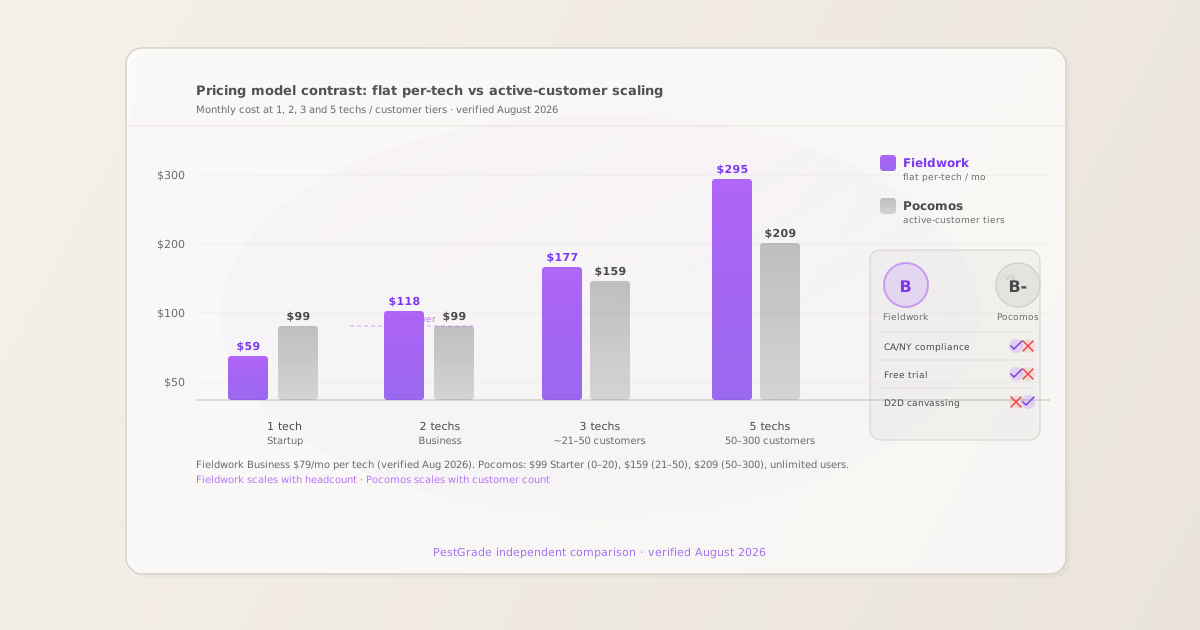
Cost implications: a solo operator pays $59–$99/mo. A 2-tech team pays $118–$198/mo. A 3-tech team pays $177–$297/mo. A 5-tech team pays $295–$495/mo. Costs scale linearly with headcount. A 14-day free trial with no credit card required is available across all plans.
Pocomos: active-customer tier pricing (verified August 6, 2026)
Pocomos charges per active customers in your database per month, with unlimited users at all tiers:
- Starter ($99/mo): 0–20 active customers, unlimited users. Includes scheduling, invoicing, route optimization, D2D canvassing CRM with territory management, canvassing leaderboards, and electronic door contracts.
- $159/mo: 21–50 active customers, unlimited users. Same feature set.
- $209/mo: 50–300 active customers, unlimited users. Same feature set.
- $275/mo: 300–500 active customers, unlimited users. Same feature set.
Cost implications: a solo operator with 15 active customers pays $99/mo (same as a 5-tech team with 15 customers). Costs scale with customer volume, not headcount. A multi-tech canvassing operation that acquires 20 customers per week will move through pricing tiers quickly. No free trial is listed on pocomos.com.
Which model is cheaper at different scales?
This is where the comparison becomes concrete:
- Solo operator, small customer base: Fieldwork Startup at $59/mo is cheaper than Pocomos Starter at $99/mo. Solo operators benefit from Fieldwork’s per-tech model.
- 2-tech team, small customer base (<20 customers): Pocomos Starter at $99/mo for unlimited users beats Fieldwork Business at $158/mo for 2 techs.
- 3-tech team, growing customer base: Pocomos $159/mo (21–50 customers) vs Fieldwork $237/mo (3 techs at Business). Pocomos maintains the cost advantage.
- 5-tech team, 100 customers: Pocomos $209/mo vs Fieldwork $395/mo (5 techs at Business). Pocomos is significantly cheaper per user as tech headcount grows.
- 5-tech team, 400 customers: Pocomos $275/mo vs Fieldwork $395/mo. Pocomos still wins on cost-per-user, but the gap narrows as the customer base grows.
The crossover point: for any operation with 2 or more technicians and a customer base under 50, Pocomos is materially cheaper than Fieldwork Business. For a solo operator or any operator in CA/NY who needs state-specific compliance formats, Fieldwork wins regardless of cost.
CA/NY compliance and device tracking: where Fieldwork wins
State-specific pesticide compliance formats (CA DPR / NY DEC)
For pest control operators licensed in California or New York, state-mandated pesticide application records must follow specific formats required by the California Department of Pesticide Regulation (CA DPR) or the New York Department of Environmental Conservation (NY DEC). Generic chemical logging that doesn’t match the state-mandated format is not compliant for audit purposes.
Fieldwork Business ($79/mo per tech) is one of the only published-price pest tools that explicitly documents CA DPR and NY DEC-compatible report formats (verified August 6, 2026 from fieldworkhq.com features). GorillaDesk documents material tracking from $49/mo Basic but does not specifically list CA DPR or NY DEC state-format reports. Pocomos lists chemical usage logging but does not document CA/NY state-specific formats. For California and New York licensed operators, this distinction is a regulatory requirement, not a preference.
QR trap device tracking
Fieldwork Business includes QR code-based device tracking at $79/mo per tech. This enables technicians to scan devices in the field (bait stations, glue boards, pheromone traps, rodent stations) with their mobile phone to log service data, update device status, and maintain a device location map. The workflow eliminates manual data entry from paper logs and ensures device service history is tied to the customer record automatically.
Pocomos does not list QR trap device tracking at any tier (verified August 6, 2026 from pocomos.com). GorillaDesk also does not document QR device tracking. For operators with commercial accounts running dense device networks where device-by-device documentation is contractually required, Fieldwork Business is one of the only transparent-price options delivering this workflow below $100/mo per tech. PestPac documents bait-station barcoding at its Enterprise tier, but does not publish pricing.
Route optimization tier comparison
Both tools include route optimization, but at different entry points:
- Fieldwork: Route optimization available from Business tier ($79/mo per tech). Not available at Startup ($59/mo).
- Pocomos: Visual route optimization included from Starter ($99/mo, unlimited users).
For a solo operator, Fieldwork Business at $79/mo is cheaper than Pocomos Starter at $99/mo for routing. For a 2-tech operation, Pocomos Starter at $99/mo (unlimited users) beats Fieldwork Business at $158/mo for 2 techs. For teams of 3 or more, Pocomos holds the routing cost advantage at every tier except when the customer base exceeds 300 (where Pocomos$275 is still cheaper than Fieldwork at $237+ per 3 techs).
D2D canvassing: where Pocomos wins
If your primary customer acquisition model is door-to-door sales with a dedicated canvassing team, Pocomos is one of two published-price tools on our rubric designed for this workflow. The D2D features are not add-ons or integrations; they are part of the core Pocomos Starter platform from the entry tier:
Territory management
Pocomos includes territory management that allows supervisors to define, assign, and track which canvassing reps are covering which geographic zones. This prevents territorial overlap, ensures coverage gaps are identified, and allows rep assignment to change when a zone underperforms. Fieldwork does not document territory management for canvassing at any tier.
Canvassing leaderboards
Performance tracking across the canvassing team via a rep leaderboard is built into Pocomos Starter. Leaderboards allow supervisors to monitor quotes generated, doors knocked, and conversions in real time. For D2D pest operations where rep performance variance is large, this visibility directly enables coaching and incentive management. Fieldwork does not document leaderboard tools at any tier.
Electronic door contracts
Pocomos allows canvassing reps to present and collect a signed service agreement at the customer’s door, without returning to the office to process paperwork. The electronic signature collected at the door is tied directly to the customer record and generates the recurring service schedule automatically. This workflow compresses the time between door knock and first scheduled service. Operators who have managed paper contracts at the door describe the gap as significant. Fieldwork does not document electronic door contract capture as a native canvassing tool.
D2D pricing model alignment
Pocomos’ active-customer pricing model is structurally aligned with D2D operations: a team of 5 canvassing reps and 3 field techs costs the same as a team of 2 reps and 1 tech for the same customer count. Adding salespeople to your canvassing floor doesn’t increase your software cost. This pricing logic matches the D2D growth model where headcount-to-customer ratios vary significantly during seasonal pushes.
What operators say, synthesized from verified sources
Sources: Capterra (26 Fieldwork reviews, verified August 6, 2026); GetApp/SoftwareAdvice (35 Pocomos reviews, verified August 6, 2026). Both sample sizes are smaller than GorillaDesk (277), Jobber (1,469), or Housecall Pro (2,742), so patterns carry more uncertainty. PestGrade has not used either tool in a live pest control business; observations are attributed as user feedback from named platforms.
What Fieldwork operators love
- Interface simplicity and onboarding speed
- The consistently highest-rated theme across Fieldwork’s 26 Capterra reviews is how quickly a solo operator or small crew can go from signup to operational. Reviewers describe a clean, modern mobile app that technicians adopt without training friction. Compared to GorillaDesk and Jobber, Fieldwork’s interface is cited as less complex, which matters for small shops without IT support. The 4.9/5 overall rating on Capterra is the highest of any tool on our rubric with meaningful review volume, though 26 reviews is a small sample to hold conclusions with high confidence.
- CA/NY compliance workflow satisfaction
- Operators in California and New York who have tried Fieldwork specifically for state compliance report generation describe the workflow as straightforward and audit-ready. The specific praise: the CA DPR format generates correctly without manual reformatting, and the mobile capture of application details (chemical, rate, location, time, license number) is well-integrated with job completion. Operators who previously managed compliance in spreadsheets describe meaningful time savings. This pattern, though from a small sample, is consistent and specific enough to be informative.
- Customer support responsiveness
- Fieldwork operators consistently cite fast, personal support as a differentiator. The perception is that the team’s small size translates into responsive direct communication rather than tiered support queues. This contrasts with patterns in GorillaDesk and Housecall Pro reviews, where support response delays appear more frequently as a frustration point for growing operations.
What Fieldwork operators note as limitations
- Per-tech cost scales with headcount
- Fieldwork operators who have grown beyond 3–4 technicians note that the per-tech pricing model creates predictable but significant cost growth as the team expands. A 5-tech team at Fieldwork Business ($395/mo) pays more than the same team at Pocomos ($99–$209/mo depending on customer count) or GorillaDesk Pro ($99/mo flat). For growth-oriented pest businesses, Fieldwork’s pricing structure is a ceiling to plan around.
- No recurring billing confirmed from public pages
- Fieldwork lists recurring billing as a capability but specific details about autopay and card-on-file management are not confirmed from public-facing documentation (verified August 6, 2026). Operators evaluating Fieldwork for quarterly pest control subscription billing should verify this workflow specifically during the 14-day free trial before committing. GorillaDesk Pro ($99/mo) is the confirmed option for subscription autopay if this is a hard requirement.
- Limited review volume for risk assessment
- 26 Capterra reviews, while uniformly positive, represent a narrow sample compared to tools like GorillaDesk (277) or Jobber (1,469). The high rating reflects genuine user satisfaction but also limits the ability to identify rare failure modes, support gaps under load, or long-term reliability patterns. For operators with low tolerance for platform risk, a tool with ten times the review volume may be the more conservative starting point.
What Pocomos operators love
- Support response speed as a genuine differentiator
- The most consistent five-star pattern across 35 Pocomos GetApp/SoftwareAdvice reviews is fast, personal customer support with 10–20 minute response times cited by multiple reviewers across different years. For a small or mid-size D2D pest operation where a platform issue during a canvassing push can cost jobs, this responsiveness matters operationally. The contrast with larger platforms (Housecall Pro, Jobber) where reviewers cite multi-day support delays is specific and recurring enough to reflect structural rather than anecdotal differences.
- D2D sales CRM and territory management
- Pocomos operators who use the D2D canvassing features consistently describe the territory management and canvassing leaderboard tools as purpose-built rather than bolted-on. Reviewers with field sales experience report that Pocomos eliminates the spreadsheet-based systems their teams previously used for territory tracking and door-to-door rep performance monitoring. For operators running 3 or more canvassing reps, this integration is described as a meaningful workflow improvement over patching together separate CRM and field service tools.
- Unlimited user pricing alignment with team growth
- Operators with high staff turnover or seasonal tech fluctuations note that Pocomos’ unlimited-user model eliminates the cost anxiety of adding seasonal help. Adding 2 additional technicians for a summer push costs nothing in Pocomos if the customer count stays in the same tier. This is a practical advantage over per-seat tools during seasonal demand peaks that require temporary headcount increases.
What frustrates Pocomos operators
- Active-customer pricing creates unpredictable cost growth
- Pocomos operators who have grown their customer base into a higher tier describe the jump from $99/mo to $159/mo (at 21 customers) and again to $209/mo (at 51 customers) as feel-abrupt compared to tools with flat pricing. For a D2D operation with aggressive customer acquisition goals, the software cost growth is directly tied to sales performance, which is counterintuitive: a high-performing canvassing push moves you into a higher pricing tier. Operators should model the full cost curve against their customer acquisition targets before committing.
- No free trial listed
- The absence of a listed free trial on pocomos.com (verified August 6, 2026) creates an evaluation friction point. Operators evaluating Pocomos cannot test the D2D canvassing workflow or the routing system without a sales conversation. For operators comparing Pocomos against Fieldwork (14-day free trial, no CC) or GorillaDesk (14-day free trial, no CC), the inability to self-serve the evaluation is a disadvantage. Contact Pocomos directly to ask about a trial or demo period before committing.
- Smaller review base limits long-term risk assessment
- 35 reviews is an insufficient sample for confident pattern analysis. The 4.5/5 rating is solid but doesn’t reveal the distribution of one-star vs five-star reviews in the same way the 71-review Briostack sample does (63% five-star, 20% one-star). For operators evaluating platform risk over a 2–3 year horizon, Pocomos’ limited review history is a legitimate concern. Request references from current Pocomos customers in a similar D2D pest operation before committing.
Right for / wrong for
- Fieldwork is right for: CA/NY licensed operators with compliance format requirements
- If your state license requires CA DPR or NY DEC pesticide application report formats and you are operating with 1–2 technicians, Fieldwork Business at $79/mo per tech is one of the only transparent-price tools that delivers these formats below $100/mo. The 14-day free trial allows you to verify the compliance report format matches your regulatory requirement before committing. This is Fieldwork’s clearest competitive advantage over every other published-price pest tool on the market.
- Fieldwork is right for: Small crews needing QR device tracking at a low confirmed price
- For pest operators with commercial accounts requiring device-by-device documentation (bait station service logs, rodent station inspections), Fieldwork Business ($79/mo per tech) delivers QR trap device tracking at a price no other published-price tool matches. PestPac Enterprise delivers bait-station barcoding but without public pricing. For small commercial pest shops where device tracking is a contract requirement on one or two accounts, Fieldwork Business is the budget-efficient path.
- Fieldwork is wrong for: Multi-tech operations where per-tech costs become prohibitive
- At 4–5 technicians, Fieldwork Business ($316–$395/mo) becomes cost-uncompetitive compared to Pocomos ($99–$209/mo), GorillaDesk Pro ($99/mo flat), or Jobber Grow ($120/mo annual). For growth-oriented pest businesses planning to scale technician count, Fieldwork’s pricing model becomes a material cost disadvantage beyond 3 techs when comparing to unlimited-user or flat-tier alternatives.
- Fieldwork is wrong for: D2D canvassing pest operations
- Fieldwork has no documented D2D canvassing CRM, territory management, canvassing leaderboard, or electronic door contract features. For operations where growth depends on a door-to-door canvassing team, Fieldwork is a service-delivery tool that does not support the acquisition model. Pocomos or Briostack (Brio Sales) are the purpose-built options for this workflow.
- Pocomos is right for: D2D canvassing pest operations with 2+ techs and a small customer base
- If your growth model is door-to-door canvassing, you have 2 or more technicians, and your active customer base is under 50, Pocomos’ combination of unlimited users, D2D CRM, and route optimization from Starter ($99/mo) is cost-efficient and purpose-built for this operational profile. No other published-price pest tool delivers this feature combination at this price point for multi-tech teams.
- Pocomos is wrong for: CA/NY compliance-specific operators
- Pocomos lists chemical usage logging but does not document CA DPR or NY DEC state-specific compliance report formats at any tier (verified August 6, 2026). CA and NY licensed operators with regulatory audit requirements should not rely on Pocomos for compliance reporting without first verifying specific format compatibility directly with Pocomos during a trial or demo.
- Pocomos is wrong for: Operators who need a confirmed free trial before evaluating
- No free trial is listed on pocomos.com. If self-serve trial access before a purchase decision is a hard requirement, Fieldwork (14-day trial), GorillaDesk (14-day trial), or Jobber (14-day trial) are the appropriate starting points. Operators committed to evaluating Pocomos should request a demo and ask specifically about trial access or a pilot period.
For CA/NY compliance and device-tracking pest shops: Fieldwork
If you are a solo or small-crew operator in California or New York, or if your commercial accounts require QR trap device documentation, Fieldwork Business at $79/mo per tech is the most cost-efficient transparent-price option for these specific requirements. Start with the 14-day free trial with no credit card required, and verify the CA DPR or NY DEC compliance report format matches your regulatory requirement before committing.
PestGrade is reader-supported. When you sign up for a tool through our links, we may earn a commission, at no cost to you, and it never affects our rankings. How we grade →
For D2D canvassing pest operations with 2+ techs: Pocomos
If your customer acquisition model is door-to-door canvassing with a dedicated sales team, Pocomos Starter at $99/mo for unlimited users delivers purpose-built territory management, canvassing leaderboards, electronic door contracts, and route optimization on the same tier. Request a demo and ask specifically about trial access or a pilot period to evaluate the D2D workflow before committing. Model the cost curve against your customer acquisition targets across all four pricing tiers.
PestGrade is reader-supported. When you sign up for a tool through our links, we may earn a commission, at no cost to you, and it never affects our rankings. How we grade →
For most dedicated pest shops: GorillaDesk
Chemical tracking from $49/mo Basic, confirmed subscription billing and route optimization from $99/mo Pro, 277 Capterra reviews at 4.8/5, and a 14-day free trial with no credit card required. For solo and small-crew pest operators without CA/NY compliance-specific format requirements or D2D canvassing needs, GorillaDesk has the highest verified satisfaction rate and the largest review sample in the category at competitive pricing.
PestGrade is reader-supported. When you sign up for a tool through our links, we may earn a commission, at no cost to you, and it never affects our rankings. How we grade →
See also: full Fieldwork review, full Pocomos review, or how we grade →
Related reading
Frequently asked questions
- Is Fieldwork better than Pocomos for pest control?
- For CA/NY compliance-specific operators and QR device tracking: Fieldwork Business ($79/mo per tech) is the better choice. For D2D canvassing operations with 2+ techs and a smaller customer base: Pocomos ($99/mo for unlimited users) is more cost-efficient and purpose-built for the D2D acquisition model. For most solo and small-crew dedicated pest shops without these specific requirements: GorillaDesk ($49/mo, chemical tracking from entry, 277 Capterra reviews at 4.8/5) outperforms both on cost-efficiency and verified platform maturity.
- What is Pocomos pricing?
- Pocomos uses active-customer tier pricing: $99/mo Starter (0–20 active customers), $159/mo (21–50 customers), $209/mo (50–300 customers), $275/mo (300–500 customers). All tiers include unlimited users (verified August 6, 2026 from pocomos.com). No free trial is listed. Costs scale with your active customer count, not your technician headcount.
- Does Fieldwork have CA/NY pesticide compliance reporting?
- Yes. Fieldwork Business ($79/mo per tech) includes CA DPR and NY DEC state-specific pesticide compliance report formats (verified August 6, 2026 from fieldworkhq.com). These are purpose-built for state regulatory audit requirements, not generic chemical logs. Verify the specific report format during the 14-day free trial before committing if your state compliance format differs from CA or NY.
- Does Pocomos include route optimization?
- Yes. Pocomos includes visual route optimization from the Starter tier ($99/mo, 0–20 active customers, unlimited users), verified August 6, 2026 from pocomos.com. Route optimization is included at all four pricing tiers. For a multi-technician team, Pocomos Starter delivers routing at $99/mo for unlimited users, which is cost-efficient compared to per-tech alternatives like Fieldwork Business ($158/mo for 2 techs) or GorillaDesk Pro ($99/mo per tech).
- Which is better for D2D pest control: Fieldwork or Pocomos?
- Pocomos is purpose-built for D2D canvassing. Pocomos Starter includes territory management, canvassing leaderboards for rep performance tracking, and electronic door contracts collected at the customer’s home, all from the $99/mo Starter tier. Fieldwork does not document equivalent D2D canvassing tools at any tier. For operations where growth depends on door-to-door sales: Pocomos or Briostack (Brio Sales) are the purpose-built options; Fieldwork is not designed for this acquisition model.
Last verified: August 7, 2026. Fieldwork pricing and features verified from fieldworkhq.com on August 6, 2026. Pocomos pricing verified from pocomos.com on August 6, 2026. Fieldwork operator feedback from Capterra (26 reviews, August 6, 2026). Pocomos operator feedback from GetApp/SoftwareAdvice (35 reviews, August 6, 2026). GorillaDesk pricing (category benchmark) from gorilladesk.com/pricing. PestGrade assesses tools from public demos, verified user reviews, and vendor documentation, never hands-on use in a live pest control business. See how we grade →