Pocomos review (2026): pricing, features & who it’s right for
PestGrade is reader-supported. When you sign up for a tool through our links, we may earn a commission, at no cost to you, and it never affects our rankings. How we grade →
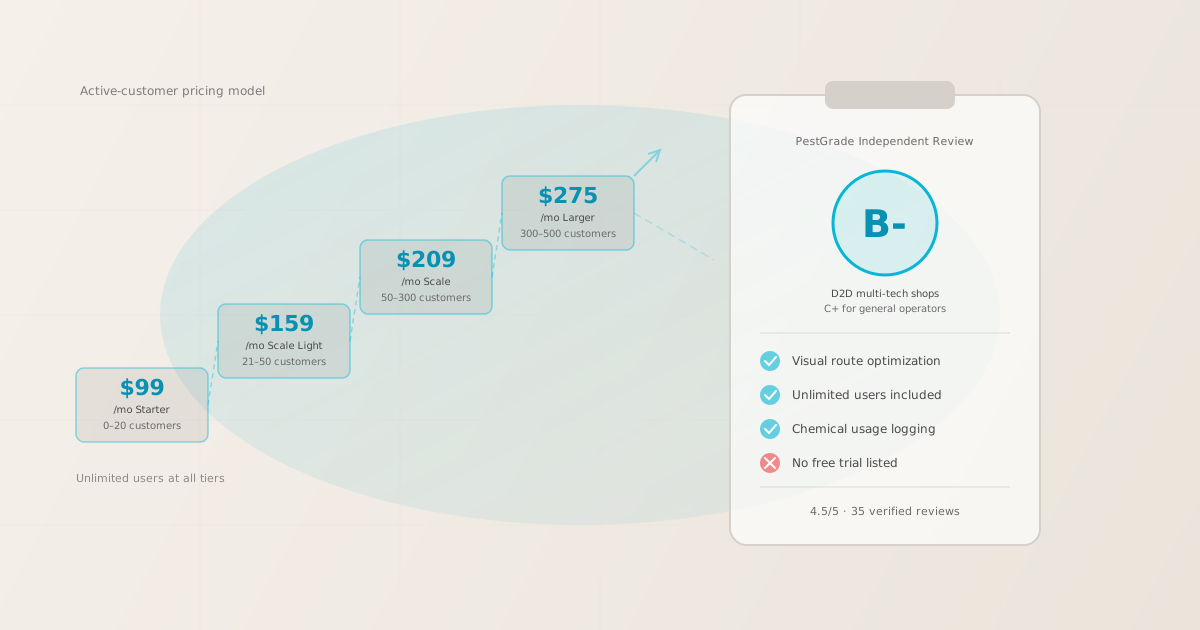
PestGrade grade: B- for D2D multi-tech shops; C+ for general operators. Pocomos charges by active customer count, not by user or seat, which makes it genuinely cost-competitive for multi-technician shops with small customer bases. Route optimization, chemical usage logging, and a built-in D2D sales CRM are real differentiators. But it costs more than GorillaDesk at nearly every scale, lists no free trial, and has 35 reviews versus GorillaDesk’s 277+. The unlimited-user model is the story.
Grade & one-line verdict
- Overall: B-right for D2D-first multi-tech pest operations with small customer bases
- Pocomos is a pest control and field service platform with a structural pricing advantage for multi-technician shops: every plan includes unlimited users, and the monthly fee scales with active customer count rather than headcount. For an operation running 4–8 technicians with 15–40 active accounts, the economics can favor Pocomos over per-seat or per-route tools. Its D2D sales CRM, territory management, canvassing leaderboards, lead tracking, is a genuine differentiator for operations that door-knock for customers. With 4.5/5 from 35 verified GetApp/SoftwareAdvice reviews, the satisfaction record is solid if small-sample.
- For general solo and small-crew operators (1–5 techs, no D2D): C+
- Once the customer base grows past 20–50 active accounts, Pocomos costs significantly more than GorillaDesk$209/mo versus $99/mo at the 50–300 customer tier. GorillaDesk also offers a 14-day free trial, no contracts, free data migration, and 277 Capterra reviews at 4.8/5. For solo operators or small residential crews not running D2D, the unlimited-user value evaporates and the cost advantage reverses. This is not a knock on Pocomos; it is a different tool built for a different operator profile.
This assessment is based on Pocomos’ public pricing page, feature pages, GetApp and SoftwareAdvice review data, and the vendor’s public documentation, not hands-on use in a live business. See how we grade.
Pocomos pricing, every tier and the real cost
Unlike FieldRoutes or Briostack, Pocomos publishes its pricing tiers openly, a meaningful advantage in a category where opacity is common. Pricing verified July 19, 2026 from pocomos.com/pricing.
| Plan | Price | Active customer range | Users |
|---|---|---|---|
| Starter | $99/mo | 0–20 customers | Unlimited |
| Scale Light | $159/mo | 21–50 customers | Unlimited |
| Scale | $209/mo | 50–300 customers | Unlimited |
| Larger | $275/mo | 300–500 customers | Unlimited |
| Enterprise / D2D | Custom, request quote | 500+ customers | Unlimited |
Pricing from pocomos.com/pricing, verified July 19, 2026. Contract terms and setup fees are not publicly listed; ask the vendor directly before signing.
The unlimited-user math. At the Starter tier ($99/mo), a 4-technician shop pays $99/mo flat regardless of how many field staff log in. GorillaDesk Basic at $49/mo is cheaper, but GorillaDesk’s pricing scales per route/schedule, so multi-tech shops with separate schedules per technician will see costs rise. At the Scale tier (50–300 customers), Pocomos costs $209/mo; GorillaDesk Pro is $99/mo. Unless your headcount-to-customer ratio is very high, GorillaDesk wins on cost past the 20-customer mark.
What’s not publicly listed. Pocomos does not list a free trial, setup fee, or contract terms on its public site. This is less opaque than Briostack (which hides its price entirely), but it means you need a direct conversation to understand onboarding costs and cancellation terms before committing.
Pocomos at a glance, the numbers
Feature data from pocomos.com/features and pocomos.com/pricing, verified July 19, 2026. Category norm reflects the common feature baseline across pest-specific FSMs at comparable price points.
| Feature | Pocomos | Category norm |
|---|---|---|
| Entry price | $99/mo (0–20 active customers) | $49–$99/mo |
| Pricing model | Active-customer count; unlimited users | Flat-rate by tier (most tools) |
| Free trial | Not listed on public site | 14 days (GorillaDesk, Jobber, Housecall Pro) |
| Setup fee | Not publicly listed | $0 setup, free data migration (GorillaDesk) |
| Contract terms | Not publicly listed | Month-to-month (GorillaDesk, Jobber) |
| Scheduling & dispatch | ✓ Visual dispatch board | Standard across all tools |
| Route optimization | ✓ Map-based routing, route density tools, drag-and-drop | Varies; algorithmic at mid-tier |
| Recurring / quarterly billing | ✓ Listed (auto reminders, statement runs) | Common at mid-tier in pest-specific tools |
| Mobile field app | ✓ iOS and Android, one-handed workflows | Standard across all tools |
| Chemical / compliance tracking | ✓ Product/chemical usage logging via mobile app | Common in pest-specific tools from entry |
| Customer communications | ✓ Integrated comms tools listed | Standard across most tools |
| D2D sales CRM | ✓ Territory management, leaderboards, lead tracking | ✗ Rare; GorillaDesk and Jobber lack D2D modules |
| QuickBooks integration | Accounting exports listed (specific integration not confirmed) | QuickBooks Online sync (GorillaDesk Pro, Jobber) |
| Verified review count (GetApp/SoftwareAdvice) | 35 reviews, 4.5/5 | GorillaDesk: 277 Capterra reviews, 4.8/5 |
Feature data from pocomos.com, verified July 19, 2026. “Not publicly listed” means the information is not on the vendor’s public site, contact Pocomos directly for current terms.
Routing & dispatch
Pocomos lists route optimization as a core feature across its plans, described as map-based routing with a drag-and-drop dispatch board, route density tools, service area controls, and real-time ETA updates (verified July 19, 2026 from pocomos.com/features).
The implementation is described as visual: operators see a map, drag stop pins to reorder runs, and can apply density tools to cluster stops geographically. Real-time changes push ETA updates to technicians. Pocomos does not describe an algorithmic optimization engine (like GorillaDesk’s Drive Matrix), but the drag-and-drop visual dispatch with density tooling is a practical workflow for operators who want to see and control their routing rather than let an algorithm decide.
For comparison: GorillaDesk Basic ($49/mo) includes basic routing up to 25 stops, and GorillaDesk Pro ($99/mo) adds Drive Matrix, a turn-by-turn algorithmic optimizer. Whether algorithmic versus visual-drag routing matters depends on your operation size. Operators with 8–20 daily stops often prefer the visual control; larger fleets benefit more from algorithmic optimization.
Recurring billing & payments
Pocomos lists billing and payments as a core feature: one-tap invoice and receipt from the mobile app, auto reminders, statement runs, and accounting exports (verified July 19, 2026 from pocomos.com/features). The platform also lists on-site payment collection from the field app.
The specific recurring billing mechanism, whether true card-on-file autopay, automated quarterly scheduling, or subscription plan management, is not detailed on the public features page. For pest control operators whose business model depends on quarterly recurring contracts, confirm with Pocomos directly whether autopay and recurring schedule automation are included at the Starter tier or require a higher plan.
GorillaDesk Pro ($99/mo) explicitly confirms subscription billing and card-on-file autopay from that tier. If automated recurring billing is a make-or-break requirement, GorillaDesk’s documented confirmation at a lower price point is an advantage worth noting.
Mobile app & chemical/compliance tracking
Pocomos’ mobile technician app is listed as a core feature: iOS and Android support, described as “one-handed workflows built for the field.” The app handles product and chemical usage logging, on-site payment processing and receipt generation, and connects to the dispatch board for real-time schedule updates (verified July 19, 2026 from pocomos.com/features).
Chemical usage logging via the mobile app covers material tracking at the job level. Whether this extends to EPA-format pesticide records, state-mandated regulatory compliance logs (such as California DPR or New York DEC requirements), or WDO/WDIR inspection reports is not confirmed on the public site. For compliance-heavy pest operations, verify these specifics with Pocomos before signing.
By comparison, GorillaDesk includes material tracking from the $49/mo Basic plan; Fieldwork includes state-specific CA/NY chemical compliance reporting at its $79/mo Business tier. If compliance documentation is the primary requirement, both are more transparent about the specific regulatory support they offer.
What operators love, and what frustrates them
Synthesis from 35 verified GetApp/SoftwareAdvice reviews (4.5/5 overall; 26 five-star, 4 four-star, 2 three-star, 2 two-star, 1 one-star), verified July 19, 2026. Individual ratings: Ease of Use 4.5, Features 4.2, Value for Money 4.5, Customer Support 4.5.
What operators appreciate: Reviewers on GetApp consistently cite the platform’s breadth for pest-specific field service management, real-time sales tracking, mobile accessibility for field staff, and integrated customer communication. The active-customer pricing model earns positive mentions from multi-technician shops, who note that being able to add staff without paying more per seat removes a friction point common with per-user pricing. Customer support responsiveness scores 4.5/5, suggesting operators who need onboarding help are getting it.
What frustrates them: The Features category scores 4.2/5, notably lower than Support (4.5) and Value (4.5), which typically signals that some expected functionality requires workarounds or is less polished than advertised. The two- and one-star reviews, though few, tend to reflect operators who found the feature set less complete for their specific workflow than the marketing suggested. The lack of a publicly listed free trial is a friction point: operators cannot evaluate the platform independently before committing, unlike GorillaDesk, Jobber, or Housecall Pro.
Who it’s wrong for: Solo operators and 2–4 tech shops with growing customer bases. The active-customer model stops being an advantage once you have more than 20–50 customers and fewer than 4–5 technicians. At that point, GorillaDesk’s flat-rate pricing at $49–$99/mo combined with its larger verified review base (277 Capterra reviews at 4.8/5) is the stronger, lower-risk choice.
Right for / wrong for
- Right for: Multi-technician operations with a small active-customer base and D2D sales
- If your shop has 4–10 technicians, 15–40 active accounts, and runs door-to-door canvassing as its customer acquisition channel, Pocomos is purpose-built for this profile. The unlimited-user model keeps labor overhead low, and the D2D CRM (territory management, leaderboards, lead tracking) adds infrastructure that GorillaDesk and Jobber don’t offer.
- Right for: Operations that want visual route management, not algorithmic black boxes
- If your dispatchers want to see the map, drag stops into logical clusters, and make routing decisions manually, Pocomos’ drag-and-drop visual dispatch with density tools matches that workflow. Some operators actively prefer visual control over algorithmic suggestions.
- Wrong for: Solo operators and 1–2 tech shops at any customer count
- The unlimited-user advantage is irrelevant for a solo operator. GorillaDesk at $49/mo is $50/mo cheaper from day one and scales to $99/mo with Drive Matrix routing and recurring billing. With a 14-day free trial and 277 verified reviews, it is the lower-risk starting point.
- Wrong for: Operations growing past 50 active customers without D2D sales
- At the Scale tier, Pocomos costs $209/mo versus GorillaDesk Pro at $99/mo. That $110/month gap compounds annually. Unless D2D sales CRM drives real business value, there is no structural reason to stay on Pocomos at this scale.
- Wrong for: Operators who want to trial before buying
- No publicly listed free trial means you’re evaluating based on demos and sales conversations, not hands-on use. GorillaDesk, Jobber, and Housecall Pro all offer 14-day free trials with full feature access.
Our pick for D2D multi-tech pest operations: Pocomos
For operations running multiple technicians with a small active-customer base and a D2D sales program, Pocomos’ unlimited-user model and built-in sales CRM make it worth a serious look. Contact Pocomos for a demo and pricing confirmation before committing.
PestGrade is reader-supported. When you sign up for a tool through our links, we may earn a commission, at no cost to you, and it never affects our rankings. How we grade →
Most operators should start here instead: see our small-business picks or the GorillaDesk review for the most widely validated option.
Our pick for general solo and small-crew operators: GorillaDesk
For most pest control operators, solo through 5-tech shops, growing customer bases, no D2D program, GorillaDesk starts at $49/mo with publicly listed pricing, a 14-day free trial, chemical tracking from entry, and 277 Capterra reviews at 4.8/5. It is the strongest verified option in the category for this profile.
PestGrade is reader-supported. When you sign up for a tool through our links, we may earn a commission, at no cost to you, and it never affects our rankings. How we grade →
Different situation? Read how we grade or compare Pocomos vs GorillaDesk head-to-head.
Frequently asked questions
- How much does Pocomos cost?
- Pocomos uses active-customer pricing: Starter $99/mo (0–20 customers), Scale Light $159/mo (21–50), Scale $209/mo (50–300), Larger $275/mo (300–500), Enterprise custom for 500+. All tiers include unlimited users. Free trial and contract terms are not publicly listed (verified July 19, 2026 from pocomos.com/pricing).
- Is Pocomos good for pest control?
- Pocomos is purpose-built for pest control and scores 4.5/5 from 35 verified GetApp/SoftwareAdvice reviews. It includes visual route optimization, chemical usage logging, mobile billing, and a D2D sales CRM. For multi-technician D2D shops it is a solid choice. For solo operators or crews with growing customer bases, GorillaDesk ($49/mo flat, 14-day trial, 277 Capterra reviews at 4.8/5) is the stronger value.
- Does Pocomos have a free trial?
- Pocomos does not list a free trial on its public website (verified July 19, 2026 from pocomos.com). GorillaDesk, Jobber, and Housecall Pro all offer 14-day free trials with full feature access, a meaningful advantage for operators who want to evaluate before committing.
- What is Pocomos’ active-customer pricing model?
- Pocomos charges by the number of active customers you service each month, not per user or technician. All plans include unlimited users. At 0–20 customers the Starter tier is $99/mo; at 21 customers it steps to Scale Light at $159/mo. This model favors shops with many technicians and few customers, and becomes more expensive than flat-rate tools once the customer base grows past 20–50 accounts.
- Is Pocomos worth it?
- For D2D multi-tech pest operations with small customer bases, yes, the unlimited-user model and dedicated D2D CRM make Pocomos genuinely competitive. For solo operators or shops growing past 50 active customers without D2D, the $109–$176/mo premium over GorillaDesk Pro ($99/mo) is hard to justify. PestGrade grades Pocomos B- for D2D multi-tech shops and C+ for general operators.