GorillaDesk vs Fieldwork vs Pocomos for pest control: three pest-specific platforms, one independent call (2026)
PestGrade is reader-supported. When you sign up for a tool through our links, we may earn a commission, at no cost to you, and it never affects our rankings. How we grade →
For most dedicated pest shops: GorillaDesk (grade A, $49/mo, routing and chemical tracking from entry, 278 Capterra reviews at 4.8/5). For CA/NY state compliance and QR trap device tracking: Fieldwork (grade B, $59/mo, CA DPR/NY DEC formats at $79/mo Business, 14-day free trial). For D2D multi-tech operations with an unlimited-user need: Pocomos (grade B-, $99–$275/mo active-customer, unlimited users, D2D canvassing CRM).
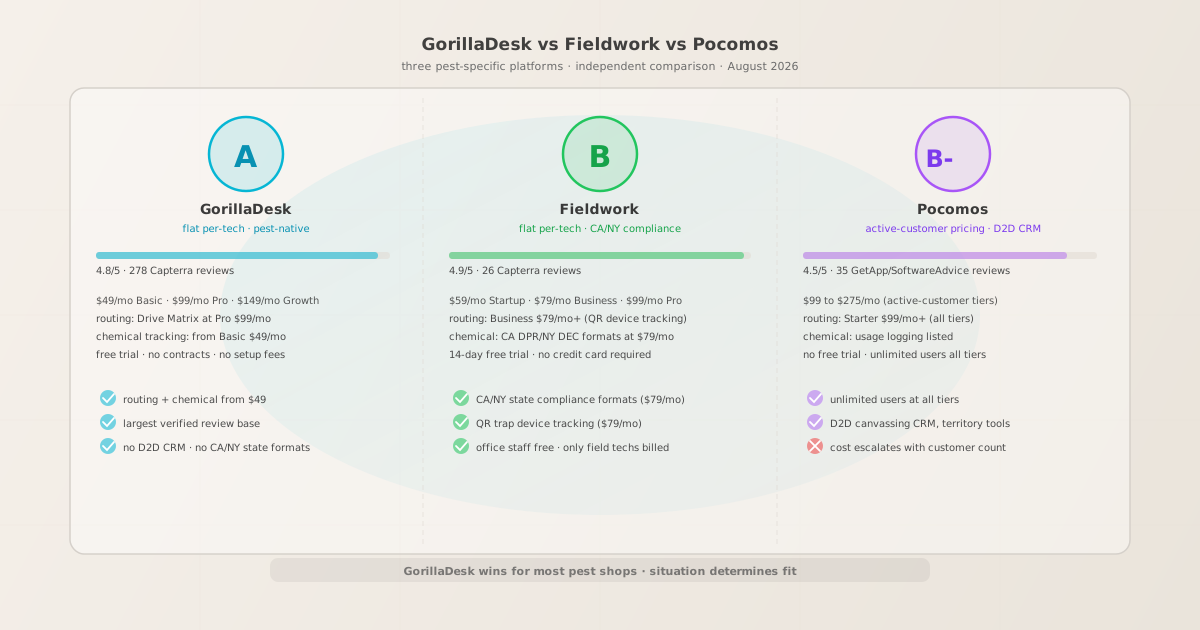
GorillaDesk vs Fieldwork vs Pocomos at a glance
All three tools are purpose-built for pest control, which makes this comparison unusual: the question isn't pest-specific vs generalist, it's which pricing model and feature emphasis matches your operation. GorillaDesk and Fieldwork both use flat per-tech pricing; Pocomos uses active-customer pricing, which favors operations with many technicians and a small customer base.
GorillaDesk pricing verified August 16, 2026 from gorilladesk.com/pricing. Fieldwork pricing verified August 16, 2026 from fieldworkhq.com/pricing. Pocomos pricing last verified July 19, 2026 from pocomos.com/pricing (site unreachable August 16, 2026; figures from prior verification retained).
| Feature |  GorillaDesk GorillaDesk |
Fieldwork | Pocomos |
|---|---|---|---|
| PestGrade grade | A | B | B- (D2D) / C+ (general) |
| Pricing model | Flat per-tech (3 published tiers) | Flat per-tech (3 published tiers, office staff free) | Active-customer tiers (price scales with customer count) |
| Published starting price | $49/mo Basic (per tech) | $59/mo Startup (per field tech) | $99/mo Starter (0–20 active customers) |
| Unlimited users | No (per-tech pricing) | No (per-tech; office staff are free, not billed) | ✓ All tiers |
| Route optimization | ✓ Pro $99/mo (Drive Matrix) | ✓ Business $79/mo+ (+ QR device tracking) | ✓ Starter $99/mo+ (visual routing) |
| Chemical / pesticide tracking | ✓ From Basic $49/mo | ✓ CA DPR/NY DEC formats at Business $79/mo | Chemical usage logging listed |
| CA/NY state compliance formats | ✗ Not documented | ✓ CA DPR and NY DEC at $79/mo Business | ✗ Not documented |
| QR trap / device tracking | ✗ Not listed | ✓ Business $79/mo+ | ✗ Not listed |
| D2D canvassing / sales CRM | ✗ Not included | Basic lead management | ✓ Territory management, electronic door contracts |
| Recurring service billing | ✓ Pro $99/mo (subscription billing) | Not confirmed on public pages | ✓ Listed |
| Customer portal / online booking | ✓ Pro $99/mo+ | ✓ Startup $59/mo+ | Listed |
| QuickBooks integration | ✓ Pro $99/mo+ | ✓ All tiers listed | Listed |
| Free trial | ✓ Yes (no CC required) | ✓ 14 days, no credit card | ✗ Not listed |
| Contract terms | No contracts, cancel anytime | Month-to-month (no contract mentioned) | Not publicly documented |
| Setup fees | None ("no setup fees") | None mentioned | Not publicly listed |
| Verified reviews | 278 Capterra at 4.8/5 | 26 Capterra at 4.9/5 | 35 GetApp/SoftwareAdvice at 4.5/5 |
Pricing from verified vendor pages. GorillaDesk and Fieldwork: August 16, 2026. Pocomos: July 19, 2026. “—” means not publicly listed. See how we grade.
Pricing model compared: per-tech vs per-tech vs active-customer
The most important number in this comparison is not the starting price, it's how cost scales as your operation grows. GorillaDesk and Fieldwork both charge per field technician at a flat monthly rate. Pocomos charges per active customer. This creates three distinct cost curves.
The compiled chart below models GorillaDesk Pro ($99/mo), Fieldwork Business ($79/mo per tech), and Pocomos at its published active-customer tiers across four operator scenarios. GorillaDesk Pro is used here (not Basic) because it includes route optimization, making it the fair comparison point against Fieldwork Business ($79/mo, also includes routing) and Pocomos Starter ($99/mo, also includes routing). Scenarios use Business-tier pricing for Fieldwork so routing is active in each.
The practical implication: if you're a solo operator with a growing residential base, Pocomos gets more expensive fast. A solo tech with 60 active customers pays $209/mo on Pocomos, versus $99/mo on GorillaDesk Pro (routing included) or $79/mo on Fieldwork Business. The Pocomos unlimited-user model only delivers a cost advantage when you have multiple technicians and a small, stable customer base.
Route optimization: where each tool unlocks it
All three tools offer route optimization, but at different price points and with different capabilities.
GorillaDesk unlocks Drive Matrix routing at Pro ($99/mo). Drive Matrix is an algorithmic route optimizer that accounts for traffic, technician start location, and job duration. The Basic tier ($49/mo) includes basic job mapping and manual scheduling but not automated optimization. For a single-tech shop where routing means getting yourself from job to job, Basic works. For a 2–3 tech crew where daily route efficiency compounds, Pro's Drive Matrix pays for itself.
Fieldwork includes route optimization at the Business tier ($79/mo), which is $20/mo less than GorillaDesk Pro per tech and also bundles QR trap device tracking. For a single-tech shop in California, Fieldwork Business at $79/mo is the lowest-cost path to routing, state compliance formats, and device tracking combined. For a 3-tech crew, Fieldwork Business totals $237/mo versus GorillaDesk Pro at $99/mo regardless of headcount.
Pocomos offers visual route optimization from the Starter tier ($99/mo), which is its cheapest plan. This is notable: routing comes with the entry price, not a tier upgrade. The trade-off is that the $99/mo Starter tier is the cheapest for a small-customer-base, many-user shop, but it escalates quickly as your customer count grows past 20.
The routing verdict: for a single-tech shop outside CA/NY, GorillaDesk Basic ($49/mo) with manual scheduling may suffice initially; upgrade to Pro ($99/mo) when daily routing efficiency is the bottleneck. For a CA/NY operator who needs routing and state compliance formats together: Fieldwork Business ($79/mo per tech) is the lowest-cost option for that combination. For a D2D multi-tech shop with fewer than 20 active customers: Pocomos Starter ($99/mo) bundles routing with unlimited users.
Chemical tracking and compliance: the most important gap to check
Chemical and pesticide tracking separates pest-specific tools from generalists. All three of these tools claim it in some form, but what's actually documented publicly differs substantially.
GorillaDesk confirms FIFRA-compliant chemical tracking from its Basic tier ($49/mo). This covers pesticide used, concentration, area treated, applicator license number, and chemical log records. It's the most explicit and entry-level chemical documentation of the three tools.
Fieldwork documents CA Department of Pesticide Regulation (CA DPR) and NY Department of Environmental Conservation (NY DEC) pesticide application report formats at the Business tier ($79/mo). This is a narrower but more specific claim: Fieldwork is not just logging chemicals, it's generating the specific state-required report formats for the two most compliance-intensive US states. For an operator in California or New York who has to submit state pesticide application reports, Fieldwork's $79/mo Business tier is the only tool in this comparison that publishes this as a direct feature. GorillaDesk's chemical tracking does not document CA/NY-specific output formats on its public pages.
Pocomos lists chemical usage logging as a feature without specifying report format or compliance level on its public pages. This likely covers basic job-level chemical recording, but the details of what fields are captured and what reports can be generated are not publicly documented. If CA/NY state compliance is a requirement, verify with Pocomos directly before committing.
The compliance verdict: for FIFRA general chemical tracking at the lowest price, GorillaDesk Basic ($49/mo). For CA DPR or NY DEC state-specific compliance report formats, Fieldwork Business ($79/mo). Pocomos's chemical logging is confirmed but underspecified; verify directly if this matters for your operation.
What operators say: synthesized from verified reviews
Patterns synthesized from Capterra, GetApp, and SoftwareAdvice reviews. No first-hand testing. All review scores as of August 2026.
GorillaDesk: what operators love
GorillaDesk draws the largest review volume of the three tools (278 Capterra reviews, 4.8/5), giving the clearest pattern-level signal. Operators consistently cite three things: the interface is genuinely intuitive for non-technical pest owners, the mobile app holds up in the field without consistent internet, and the support team responds quickly to problems. Routing operators credit Drive Matrix with meaningful route compression. Chemical log records are frequently mentioned as a reason operators moved from spreadsheets or paper logs.
GorillaDesk: what frustrates them
The most common frustrations in GorillaDesk reviews are reporting depth (some operators want more granular financial or technician performance reports) and the fact that basic reporting is in the lower tiers while advanced analytics are Growth-tier features ($149/mo). A minority of reviewers note that pricing increased when adding additional routes or technicians, though GorillaDesk's published model is flat per route/tech with no hidden surcharges disclosed. A smaller set of reviews mention SMS messaging as an additional cost ($5/mo for the add-on).
Fieldwork: what operators love
Fieldwork's 26 Capterra reviews are uniformly positive (4.9/5, 100% positive signal). CA-based operators specifically credit the state compliance report generation as the reason they chose Fieldwork over GorillaDesk: having CA DPR-formatted reports built into the software removes manual formatting work after each job. Reviewers also consistently praise onboarding responsiveness and the clean mobile app experience. The QR trap device tracking feature is mentioned by operators running rodent-control and IPM programs who need to document trap checks at specific device locations.
Fieldwork: what frustrates them
The review base is small (26 reviews), which limits pattern confidence. The clearest gap across reviews is recurring billing: Fieldwork's public pages do not confirm subscription billing or recurring service plan management, which is a core requirement for most quarterly-recurring pest accounts. Operators who need automated recurring billing should verify this feature directly with Fieldwork before committing, or consider GorillaDesk Pro ($99/mo, confirmed recurring billing) as the alternative.
Pocomos: what operators love
Pocomos's 35 GetApp/SoftwareAdvice reviews (4.5/5) consistently highlight two genuine advantages: the unlimited-user model lets multi-tech D2D shops add office staff and canvassers without per-seat cost increases, and the D2D canvassing CRM with territory management and electronic door-contract signing is genuinely differentiated from what GorillaDesk and Fieldwork offer. Operators running D2D acquisition programs credit Pocomos's territory tools with cleaner route planning for canvassers, distinct from field-service route optimization. Support responsiveness is frequently cited as a positive, with 10–20 minute response times mentioned in multiple reviews.
Pocomos: what frustrates them
The active-customer pricing model is the most common frustration: operators who grew their customer base past 20–50 accounts found costs escalating faster than expected as they crossed tier thresholds. The lack of a free trial is also cited, particularly for operators comparing Pocomos against GorillaDesk and Fieldwork (both of which offer trials). A subset of reviewers note that mobile app performance is inconsistent in low-connectivity field conditions, though this does not dominate the negative signal. No free trial means there's no low-risk way to evaluate the platform before committing.
Who it's wrong for: Pocomos is a poor fit for solo operators or 2-tech shops with a growing customer base. Once you pass 50 active customers, Pocomos costs $209/mo, at which point GorillaDesk Pro ($99/mo) and Fieldwork Business ($79/mo per tech for a 1-tech shop, $158/mo for 2 techs) are materially cheaper and include routing. The D2D CRM advantage only matters if you actually run canvassing acquisition. If your growth comes from referrals and Google, not door-to-door, Pocomos's pricing model works against you.
Right for / wrong for: the situational breakdown
- GorillaDesk is right for: most dedicated pest shops
- If you run a 1–5 tech pest operation that needs scheduling, routing, recurring billing, chemical tracking, and a mobile app, GorillaDesk is the strongest all-around choice in this comparison. The Basic tier ($49/mo) handles the fundamentals; Pro ($99/mo) adds Drive Matrix routing and subscription billing. The 278-review Capterra base at 4.8/5 is the most reliable quality signal of the three tools. Free trial, no contracts, no setup fees lower the risk of trying it.
- GorillaDesk is wrong for: CA/NY compliance specialists and D2D canvassing operations
- GorillaDesk does not publish CA DPR or NY DEC state compliance report formats, and it includes no D2D canvassing CRM. If those are core operational requirements, look at Fieldwork (compliance) or Pocomos (D2D) instead.
- Fieldwork is right for: CA/NY state-regulated operators and QR device tracking shops
- If your operation is in California or New York and you submit state pesticide application reports, Fieldwork's Business tier ($79/mo per tech) includes CA DPR and NY DEC format output. This is the single most differentiated feature in this comparison for a regulated CA/NY pest shop. QR trap device tracking at the same $79/mo tier is a bonus for operators running rodent IPM programs with many trap locations to document.
- Fieldwork is wrong for: operators outside CA/NY needing recurring billing confirmation
- Fieldwork's state compliance advantage is specific to California and New York operators. For all other US states, GorillaDesk's explicit FIFRA chemical tracking from $49/mo is the cleaner choice. Recurring service billing is not confirmed on Fieldwork's public pages, making it a poor fit for any operator whose business depends on quarterly or monthly recurring service agreements as a confirmed feature.
- Pocomos is right for: D2D multi-tech shops with small, stable customer bases
- If you run a D2D acquisition model with multiple technicians and a relatively small customer base (under 50 active accounts), Pocomos's unlimited-user pricing combined with its territory management and door-contract tools make it genuinely competitive. At 4–5 technicians and 20 customers, Pocomos Starter ($99/mo) beats GorillaDesk Pro ($99/mo) on user count and includes D2D tools not available on GorillaDesk or Fieldwork.
- Pocomos is wrong for: growing operations and solo operators
- The active-customer pricing model penalizes growth. A solo operator at 60 customers pays $209/mo on Pocomos versus $99/mo on GorillaDesk Pro or $79/mo on Fieldwork Business. No free trial means no risk-free evaluation period. Operators who grow to 100+ customers per year will hit the $209/mo and $275/mo tiers and find themselves paying 2–3x what flat-rate tools cost.
Related reading
Our pick for most pest shops: GorillaDesk
For a dedicated pest operation that needs routing, chemical tracking, and recurring billing in a pest-native platform with transparent pricing and a free trial, GorillaDesk is the strongest all-around option in this comparison. Start on Basic ($49/mo) for scheduling and chemical logging; upgrade to Pro ($99/mo) when Drive Matrix routing and subscription billing become the next bottleneck.
PestGrade is reader-supported. When you sign up for a tool through our links, we may earn a commission, at no cost to you, and it never affects our rankings. How we grade →
Our pick for CA/NY compliance: Fieldwork
For operators in California or New York who submit state pesticide application reports, Fieldwork Business ($79/mo per field tech) is the lowest-cost path to CA DPR and NY DEC format compliance, route optimization, and QR trap device tracking combined. Start the 14-day free trial before committing.
PestGrade is reader-supported. When you sign up for a tool through our links, we may earn a commission, at no cost to you, and it never affects our rankings. How we grade →
Our pick for D2D multi-tech ops with small customer bases: Pocomos
If your operation runs door-to-door acquisition with multiple technicians and a customer base under 50 active accounts, Pocomos's unlimited-user model and territory management tools make it worth evaluating. Contact Pocomos for a demo and confirm pricing before committing; contract terms are not publicly listed.
PestGrade is reader-supported. When you sign up for a tool through our links, we may earn a commission, at no cost to you, and it never affects our rankings. How we grade →
Different situation? See our full small business software guide or read how we grade.
Last verified: August 16, 2026. GorillaDesk pricing verified from gorilladesk.com/pricing on August 16, 2026. Fieldwork pricing verified from fieldworkhq.com/pricing on August 16, 2026. Pocomos pricing last verified from pocomos.com/pricing on July 19, 2026 (site unreachable August 16, 2026; prior figures retained). Review scores from Capterra and GetApp/SoftwareAdvice as of August 2026. This assessment is based on public demos, verified user reviews, and vendor documentation, not hands-on use. See how we grade.
FAQ
- GorillaDesk vs Fieldwork vs Pocomos: which pest control software is best overall?
- GorillaDesk (grade A) wins for most dedicated pest shops: routing and chemical tracking from $49/mo, 278 Capterra reviews at 4.8/5, free trial, no contracts. Fieldwork (grade B) wins for CA/NY state compliance and QR trap device tracking at $79/mo Business, with a 14-day free trial. Pocomos (grade B- for D2D) wins for multi-tech D2D operations with small customer bases and an unlimited-user need. No single tool wins across all situations.
- Does Pocomos have a free trial?
- No free trial is listed on Pocomos's public pricing page. GorillaDesk and Fieldwork both offer free trials with no credit card required. If the ability to try before buying matters for your evaluation, GorillaDesk and Fieldwork are the lower-risk options.
- Is Fieldwork available outside California and New York?
- Yes. Fieldwork is a general pest control FSM platform available in all US states. The CA DPR and NY DEC state pesticide compliance formats are additional features for operators in those states; they do not limit Fieldwork's availability elsewhere. For operators outside CA/NY who need general chemical tracking, GorillaDesk confirms this feature more explicitly from its entry tier.
- What is Pocomos' active-customer pricing model?
- Pocomos charges by the number of active customers you service each month, not per user or technician. All plans include unlimited users. Published tiers (last verified July 19, 2026): Starter $99/mo (0–20 active customers), Scale Light $159/mo (21–50), Scale $209/mo (51–300), Larger $275/mo (301–500), Enterprise custom for 500+. This model favors operations with many staff members and a small active-customer base. It becomes more expensive than flat-rate tools once the customer base grows past 20–50 accounts.
- Which of these tools is best for a solo pest control operator?
- GorillaDesk Basic ($49/mo) is the strongest solo option in this comparison. It includes scheduling, invoicing, chemical tracking, payments, and the core mobile app at the entry tier. Upgrade to Pro ($99/mo) when Drive Matrix route optimization and subscription billing become needed. Fieldwork Startup ($59/mo) is a viable solo alternative with a clean interface and free trial; Business ($79/mo) adds routing and CA/NY compliance. Pocomos Starter ($99/mo) is the most expensive entry price for a solo operator and its unlimited-user advantage is irrelevant at 1-tech scale.