Switching from Fieldwork for pest control: how to migrate and what to move to (2026)
PestGrade is reader-supported. When you sign up for a tool through our links, we may earn a commission, at no cost to you, and it never affects our rankings. How we grade →
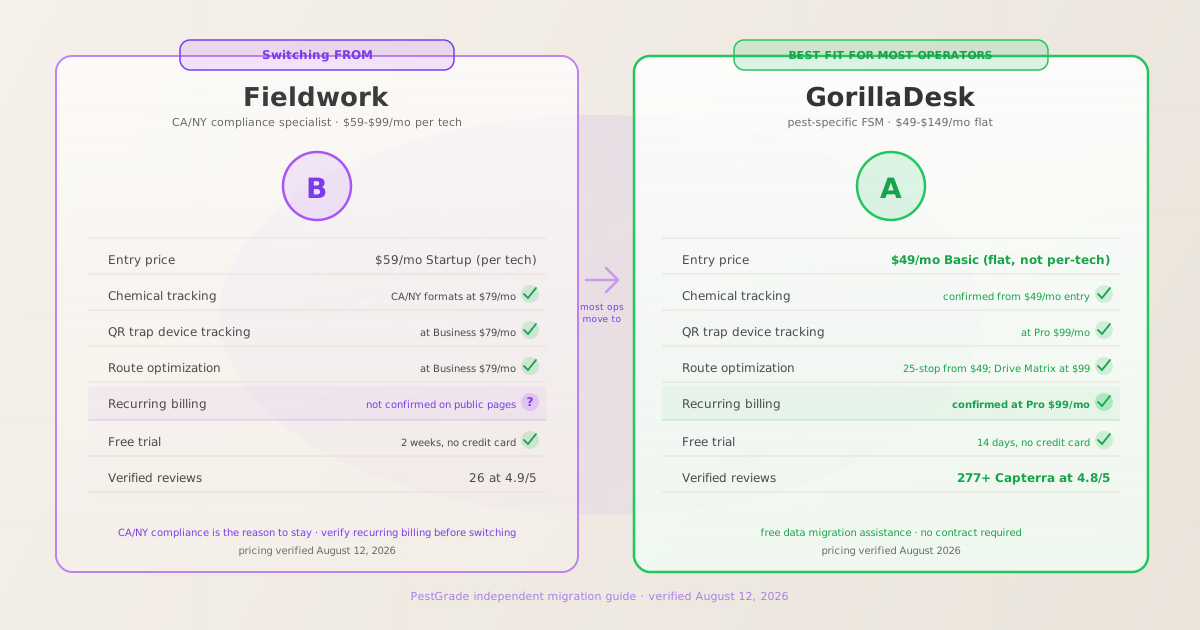
For most pest operators leaving Fieldwork, the destination is GorillaDesk ($49/mo entry, confirmed chemical tracking from entry, confirmed recurring billing at $99/mo Pro). If you are in California or New York and depend on state-specific compliance report formats, Fieldwork may still be the right tool. Here is the independent breakdown of who should switch, where to go, and how migration works from a platform with no published contract lock-in.
The short answer: who should switch and where to go
- Most pest operators needing confirmed recurring billing: GorillaDesk Pro at $99/mo
- Subscription and recurring billing are not documented on Fieldwork’s public pricing or features pages (fieldworkhq.com/pricing and fieldworkhq.com/features, verified August 12, 2026). If automated quarterly or annual billing is a core workflow for your business, GorillaDesk Pro ($99/mo) explicitly confirms subscription billing, autopay, and card-on-file recurring services. GorillaDesk also starts $10/mo cheaper at entry ($49 vs $59), includes chemical tracking from entry (Fieldwork notes chemical tracking as a features-page capability but does not specify the tier), and has 277+ Capterra reviews at 4.8/5 versus Fieldwork’s 26 reviews.
- Solo operators on a budget: GorillaDesk Basic at $49/mo
- GorillaDesk Basic at $49/mo starts $10/mo cheaper than Fieldwork Startup, includes basic 25-stop routing and confirmed chemical tracking. Fieldwork Startup at $59/mo includes scheduling and invoicing but does not include route optimization. For a single-tech operation where entry cost matters most, GorillaDesk wins on price and on feature confirmation.
- Multi-trade operations (pest plus other services): Jobber
- Jobber Core at $49/mo monthly supports mixed field-service businesses with a broad integration library, strong customer management, and 1,471 GetApp reviews at 4.6/5. Routing unlocks at Grow ($199/mo monthly). Jobber has no chemical tracking at any tier, so it is not the right call for compliance-first pest shops, but it is the stronger pick for multi-trade operations that value Jobber’s generalist depth.
- California and New York compliance-specific operators: consider staying on Fieldwork
- Fieldwork’s features page (verified August 12, 2026) specifically lists California and New York state pesticide compliance report formats. These are state-level CDFA and DEC requirements that GorillaDesk does not explicitly document in its public materials. If your chemical records must match those specific state formats and you are not encountering the recurring billing gap in practice, Fieldwork Business at $79/mo (which also includes QR device tracking and route optimization) may be the right tool for your situation. See our full Fieldwork review for the complete assessment.
- Commercial multi-truck operations: FieldRoutes or PestPac
- For established multi-truck commercial operations that have grown past what Fieldwork is designed for, FieldRoutes (ServiceTitan-owned, enterprise route automation, custom pricing) or PestPac (WorkWave, commercial IPM depth, bait-station barcoding) are the enterprise-tier options. Neither publishes pricing transparently, so you need a demo call. See best for commercial accounts for the full comparison.
Three reasons operators evaluate Fieldwork alternatives
- 1. Recurring billing is not explicitly confirmed on public documentation
- Fieldwork’s pricing page (fieldworkhq.com/pricing, verified August 12, 2026) lists invoicing, mobile apps, and QuickBooks integration across all tiers. The features page (fieldworkhq.com/features) describes automated invoicing and batch billing, but does not name subscription billing, recurring service plans, or autopay as confirmed features. This matters for pest operators whose business model depends on quarterly or annual service contracts with automatic billing. GorillaDesk Pro ($99/mo) explicitly lists subscription billing, autopay, and card-on-file recurring as named features in its Pro tier documentation. Operators who have asked Fieldwork directly about recurring billing should verify the current state of this feature before making any switch decision.
- 2. Entry price is $10/mo higher than GorillaDesk, with routing locked behind an additional tier
- Fieldwork Startup at $59/mo includes CRM, scheduling, invoicing, and mobile apps, but does not include route optimization. Route optimization requires the Business tier at $79/mo. GorillaDesk Basic at $49/mo includes basic 25-stop routing alongside chemical tracking, and Drive Matrix algorithmic optimization unlocks at $99/mo Pro. For a solo operator who wants routing from entry, GorillaDesk starts cheaper and includes routing at a lower tier. For a small crew that needs route optimization and is comfortable paying $79/mo, Fieldwork Business is a viable alternative to GorillaDesk Basic ($49) if CA/NY compliance formats matter.
- 3. Smaller verified review base creates less independent validation
- Fieldwork has 26 verified reviews on Capterra at 4.9/5 (100% positive, GetApp as of August 12, 2026). GorillaDesk has 277+ Capterra reviews at 4.8/5. For operators researching tools, a smaller review base means fewer independent accounts of real-world performance across different business types, geographies, and use cases. The 4.9/5 rating is genuinely strong, but the small sample means edge cases and long-term platform behavior are less documented than for GorillaDesk, Jobber, or Housecall Pro. This is not a negative mark on Fieldwork’s software quality; it reflects the platform’s smaller current user base, not its rating.
Best-fit replacements compared
Data compiled from verified vendor pricing pages. Fieldwork: fieldworkhq.com/pricing, verified August 12, 2026. GorillaDesk: gorilladesk.com/pricing, verified August 10, 2026. Jobber: jobber.com/pricing, verified August 10, 2026.
| Feature | Fieldwork (leaving) |  GorillaDesk GorillaDesk |
 Jobber Jobber |
|---|---|---|---|
| Entry price | $59/mo (Startup, per field tech) | $49/mo flat (Basic) | $49/mo (Core, monthly) |
| Pricing model | Per field technician | Flat monthly tiers | Per user (flat tiers) |
| Admin/office users | ✓ Free, not counted as users | ✓ Free, not counted | Additional users $29/mo each |
| Chemical tracking | ✓ CA/NY formats at Business $79/mo | ✓ Confirmed from Basic $49/mo | ✗ No tier includes it |
| Route optimization | ✓ At Business $79/mo | ✓ 25-stop from $49; Drive Matrix at $99 | ✓ At Grow $199/mo (monthly) |
| Recurring billing | Not confirmed on public pages | ✓ Confirmed at Pro $99/mo | ✓ Recurring jobs from Core |
| QR device/trap tracking | ✓ At Business $79/mo | ✓ At Pro $99/mo | ✗ Not listed |
| CA/NY state compliance formats | ✓ Listed on features page | Not explicitly documented | ✗ Not listed |
| Free trial | 2 weeks, no credit card | 14 days, no credit card | 14 days, no credit card |
| Contract terms | Not publicly listed | Month-to-month, no contract | Month-to-month or annual |
| Data migration | Contact vendor; not documented | Free migration assistance advertised | Self-serve CSV import tools |
| Verified reviews | 26 Capterra at 4.9/5 | 277+ Capterra at 4.8/5 | 1,471 GetApp at 4.6/5 |
Fieldwork pricing verified August 12, 2026 from fieldworkhq.com/pricing. GorillaDesk and Jobber verified August 10, 2026. “Not confirmed on public pages” means the feature is not named in the vendor’s public pricing or features documentation; it does not mean the feature does not exist. Verify directly with the vendor.
How migration actually works from Fieldwork
Fieldwork offers a 2-week free trial with no credit card required. This is a meaningful operational advantage over tools with opaque pricing or known annual contracts: you can start your destination platform trial while still on Fieldwork, run them in parallel without a financial commitment, and only cancel Fieldwork once the migration is verified. This is based on Fieldwork’s public trial terms (fieldworkhq.com, verified August 12, 2026); not hands-on use.
- Step 1: Confirm Fieldwork’s export format and cancellation terms before anything else
- Fieldwork does not publicly document a data export process or cancellation policy. Contact Fieldwork support before starting a migration and ask: (a) What format does data export in (CSV is standard; JSON or proprietary formats may complicate imports)? (b) What is the notice period to cancel? (c) Are there any early-termination fees? Since Fieldwork advertises a no-credit-card trial and does not list contract terms, cancellation is likely month-to-month, but confirm in writing. Get the data export request in early; some platforms take 1–2 weeks to generate a full export.
- Step 2: Export chemical logs and device tracking records carefully
- Fieldwork’s chemical tracking records, particularly for CA and NY operators, may need to match specific state format requirements even after export. If you are moving to GorillaDesk, confirm with GorillaDesk support whether their import process preserves the chemical application log data in a format compatible with your compliance needs. For CA/NY operators moving platforms, the transition period (while both platforms are active) is the safest time to verify that historical compliance records are either retained in Fieldwork or fully transferred. If your CA DPR or NY DEC records live in Fieldwork, make sure you have a verified export of those records before deactivating the account.
- Step 3: Start your GorillaDesk trial while still on Fieldwork
- GorillaDesk offers a 14-day free trial with no credit card required. Start it while Fieldwork is still active. Import your customer data and run a test service workflow, route, and billing cycle in GorillaDesk before committing. GorillaDesk advertises free data migration assistance; contact their migration team with your Fieldwork export format before you start the trial so they can advise on import steps. This parallel-run approach costs nothing (both are on free trials simultaneously) and eliminates the risk of data loss or process gaps.
- Step 4: Technician retraining on the new mobile app
- GorillaDesk has a separate mobile app from Fieldwork. Budget 1–2 weeks of parallel running for technicians to get comfortable with the new app before you fully deactivate Fieldwork. The GorillaDesk app (iOS and Android) is rated 4.7/5 on the App Store and 4.3/5 on Google Play. If your team does most of their work on Android, verify the GorillaDesk Android experience during the trial before committing. The most common migration friction is technicians defaulting to the old app; run the new app on a few routes before the cutover date.
- Step 5: Recurring billing and card-on-file re-authorization
- Stored payment card data is PCI-scoped and cannot move between payment processors. Any customers with a card on file for recurring billing will need to re-enter their payment details on the GorillaDesk platform. Build a communication plan for this step: a text or email with a link to the new payment portal or a card-update request. Time this 2–3 weeks before the first billing cycle on the new platform. For operators with large volumes of recurring quarterly accounts, this re-authorization is the highest-friction step. It is also why confirming that GorillaDesk’s subscription billing is set up correctly during the trial period matters before the full cutover.
What Fieldwork operators say
Synthesized from 26 verified Capterra and GetApp reviews (4.9/5 overall, 100% positive), as of August 12, 2026. PestGrade does not use Fieldwork in a live business; assessments are from public review platforms. The review base is small by category standards (GorillaDesk: 277+, Jobber: 1,471), so patterns may shift as more reviews accumulate.
- What operators consistently praise
- Ease of use is the dominant positive across Fieldwork’s reviews. Multiple reviewers note that the platform is intuitive for both technicians in the field and office staff learning the system. One GetApp reviewer who has used Fieldwork both as a technician and as an owner notes that it has “always been easy to use and figure out.” Value for money (5.0/5 on GetApp) is the highest-rated subcategory, suggesting that operators feel the pricing is appropriate relative to the features delivered. The QuickBooks integration and custom form capabilities are cited positively for operators who need them. No single reviewer among the 26 public reviews describes a negative experience, the 100% positive distribution across a small sample. CA/NY compliance operators specifically value the state-specific report formats that are difficult to find in comparable-priced tools.
- What is less visible in the review base
- With 26 reviews, patterns around recurring billing, long-term customer support reliability, and scalability to 5+ technicians are not well-documented. The review base is too small to establish the kind of pattern-level insights that are possible from GorillaDesk’s 277 reviews or Jobber’s 1,471 reviews. This does not mean Fieldwork has hidden problems; it means independent validation of edge cases is limited. Operators evaluating Fieldwork for a use case not clearly covered by CA/NY compliance or QR device tracking should ask Fieldwork directly for references from operations similar to theirs before committing.
- Who Fieldwork is wrong for, based on available evidence
- Operators whose primary requirement is confirmed automated recurring billing for quarterly or annual service plans should verify this directly with Fieldwork before switching from any other tool or signing up. The public documentation does not confirm this feature, and the small review base means independent reports of the recurring billing workflow are scarce. Operators with 3+ technicians where per-tech pricing scales more expensively than per-account or flat-rate tools should run the cost math: 3 technicians on Fieldwork Business ($79/mo each) equals $237/mo; GorillaDesk Pro ($99/mo flat, no per-tech fee) is a meaningful difference at that scale. Operators outside California and New York who do not use QR trap device tracking lose Fieldwork’s two main differentiators, and GorillaDesk’s feature confirmation and lower entry price become the clearer choice.
Who should stay on Fieldwork
Fieldwork earns a PestGrade grade of B. It is a legitimate pest-specific FSM with a strong rating (4.9/5) and real differentiators. Not every operator evaluating alternatives needs to switch.
- California and New York compliance-specific operators
- Fieldwork’s state-specific CA and NY compliance report formats are a genuine differentiator. California’s Department of Pesticide Regulation (DPR) and New York’s Department of Environmental Conservation (DEC) have specific pesticide application record requirements. If your operation already uses Fieldwork’s compliance forms and your state audit workflow depends on them, the cost of switching (rebuilding compliance record formats in a new tool, retraining staff, verifying historical data transfer) may not justify the savings. Verify with GorillaDesk whether their chemical tracking export format would satisfy your CA/NY reporting requirements before making a switch decision.
- Operators who need QR device/trap monitoring before the $99 price point
- QR barcode device and trap tracking is available in Fieldwork at the Business tier ($79/mo). GorillaDesk includes QR device tracking at its Pro tier ($99/mo). For operators running active trap monitoring workflows on a budget, Fieldwork Business at $79/mo delivers device tracking for $20/mo less than GorillaDesk Pro. If device monitoring is central to your service model and you don’t want to pay $99/mo, Fieldwork Business is the lower-cost option in this specific combination.
- Operators satisfied with the existing feature set
- Fieldwork scores 4.9/5 from all 26 available reviews, a genuinely strong signal from its current user base. If you are not experiencing the recurring billing gap in practice (either you don’t need recurring autopay, or Fieldwork is delivering it via a process not documented on public pages), and your team has adapted to the tool successfully, the switching cost (migration labor, technician retraining, re-authorizing payment cards) is real and may not be worth a $10/mo savings. Switching costs typically take 4–6 months to break even on a $10–20/mo price difference.
Our pick for most operators leaving Fieldwork: GorillaDesk
GorillaDesk starts cheaper ($49/mo vs $59/mo), explicitly confirms chemical tracking from entry and recurring billing at $99/mo Pro, includes 25-stop routing at the entry tier, and has 277+ Capterra reviews at 4.8/5 for independent validation. The 14-day free trial and free migration assistance let you verify the migration before committing. For most pest operators outside California and New York who need confirmed recurring billing, it is the stronger choice.
PestGrade is reader-supported. When you sign up for a tool through our links, we may earn a commission, at no cost to you, and it never affects our rankings. How we grade →
Multi-trade operations: see our Jobber review. CA/NY compliance operators evaluating both tools: see our Fieldwork vs GorillaDesk head-to-head.
FAQ
- What is the best alternative to Fieldwork for most pest operators?
- GorillaDesk: $49/mo Basic (chemical tracking from entry, 25-stop routing, no contracts), $99/mo Pro (Drive Matrix routing, confirmed subscription and recurring billing, QuickBooks sync, customer portal). 277+ Capterra reviews at 4.8/5. 14-day free trial, no credit card. Free data migration assistance. Starts $10/mo cheaper at entry and confirms recurring billing that Fieldwork does not document publicly.
- Why do operators evaluate alternatives to Fieldwork?
- The primary driver is that recurring billing is not explicitly confirmed on Fieldwork’s public pricing or features pages (verified August 12, 2026). Secondary reasons: entry price is $10/mo higher than GorillaDesk; routing requires the $79/mo Business tier while GorillaDesk includes routing from $49/mo; the review base (26 reviews) is smaller than GorillaDesk (277+) for independent validation. Fieldwork’s CA/NY compliance formats and QR device tracking are genuine differentiators that may justify staying for the right operator.
- Does Fieldwork have recurring billing?
- Recurring billing is not named as a feature on Fieldwork’s pricing or features pages as of August 12, 2026. The platform lists automated invoicing and batch billing, but not subscription or recurring service plan autopay. Verify this directly with Fieldwork before any decision. GorillaDesk Pro ($99/mo) explicitly documents subscription billing.
- What data can you export from Fieldwork?
- Fieldwork does not publicly document its export process. Contact Fieldwork support to request customer records, service history, chemical logs, device tracking records, and active agreements. GorillaDesk advertises free migration assistance. Payment cards cannot transfer (PCI-scoped); customers re-enter on the new platform. The 2-week free trial means likely no contract lock-in, but verify before canceling.
- Should CA/NY pest operators switch from Fieldwork?
- Not necessarily. Fieldwork lists California and New York state-specific pesticide compliance report formats on its features page, a differentiator GorillaDesk does not explicitly advertise. For CA/NY operators whose compliance workflow depends on these state formats, Fieldwork Business at $79/mo may still be the right choice. Evaluate whether GorillaDesk’s chemical tracking export format satisfies your state reporting requirements before switching. See our Fieldwork vs GorillaDesk head-to-head for the full CA/NY compliance analysis.
Last verified: Fieldwork pricing and features from fieldworkhq.com/pricing and fieldworkhq.com/features, verified August 12, 2026. GorillaDesk pricing from gorilladesk.com/pricing, verified August 10, 2026. Jobber pricing from jobber.com/pricing, verified August 10, 2026. Review counts from GetApp/Capterra as of August 2026. This guide is based on public pricing pages, vendor feature documentation, and verified user review synthesis, not hands-on use of the software. See how we grade.